#phdchat, ATPI, PhD, Professional Development, Reflections

ATPI Doctoral Portfolio Reflection

This weekend will involve the usual researching, writing, and editing of projects – however I have one more item to polish up before it’s time to be thankful in the U.S. – my doctoral portfolio.

For the Applied Technology & Performance Improvement Doctorate (ATPI) program, the doctoral portfolio is a new requirement for us young, budding scholars. Rather than sit in a room for two 8-hour days or respond to a set of questions over a period of time, ATPI doctoral students will need to complete our departments Ph.D. portfolio to officially become a Doctoral Candidate and move forward with dissertation work. Some students in our program are still opting to take the comprehensive exam route while they still can, only because the requirements include research, teaching, and service scholarship experience that is akin with academics who might be seeking tenure/promotion. I think that this portfolio makes sense, professionally it helps to document my PhD Journey and encourages students to gain scholarship experience before being launched into a dissertation or even the academic job search.

Here are the ATPI Doctoral Portfolio Requirements [DRAFT] that I have been using to guide my portfolio development. {I say draft as this document is subject to change since our department will have myself and another student defend in December for the 1st time.}

I promise to share my ATPI doctoral portfolio, after I review it and put the finishes touches on it. I learned a great deal from our “dry-run” on Friday, and I was reminded about some of the key things to highlight in my 15-minute presentation. I am also pleased to say that I will be sharing my digital PhD journey (blogging, tweeting, and then some) with my doctoral committee for my portfolio defense. My faculty advisor and another committee member thought it would be valuable to discuss my philosophy and experience as an open educator/scholar/researcher.

In thinking about how to “show case” some of this, I am looking through my blog for musings and what I have been up to over the last 3 years of my doctoral course work. So far my TechKNOW Tools Wordle reflects this:

TechKNOW Tools Blog Wordle

I also know that my digital footprint can be found in my Google Docs (or now Drive), YouTube channel, Dropbox, shared on my SlideShare account, posted on my Flickr account in photos, and even among my 23, 926 tweets (good thing I auto-send these into Delicious with hashtags for easy searching). Time to mine my own digital data, review what I’ve created, and compile my professional development and scholarship.

Grad Students & PhD Friends: How do you track your progress? Professional development? Teaching, service, and research scholarship? Please share!

PhD, Virtual Communities

Actor-Network Theory in Education

Give Me Some Theory... #LitReview

Actor-Network Theory has recently been referred to by Law (2007, p. 595) as  the ‘diaspora’ of

“tools sensibilities and methods of analysis that treat everything in the social and  natural worlds as a continuous generated effect of the webs of relations within which they are located. It assumes that nothing has reality or for outside the enactment of those relations.”

Further research in this theory helps scholars and researchers discover new approaches to a number of educational issues. In considering educational research, with regards to schools, universities/colleges, community agencies, corporate training organizations, and professional affiliations, ANT merges knowledge as situated, embodied and distributed.

Fenwick and Edward (2010) share how ANT challenges a number of assumptions that lie in educational conceptions of development, learning , agency, identity, knowledge and teaching. ANT identifies rich interconnections in both social and cognitive activity. As shared in the book, Neyland (2006, p. 45) has the ability to contribute to educational understanding of:

“mundane masses (the everyday and the humdrum that are frequently overlooked), assemblages (descriptions of things holding together), materiality (that which does or does not endure), heterogeneity (achieved diversity within assemblage), and flows/fluidity (movement without necessary stability).”

For those interested in reading the book in more detail, you will appreciate how Fenwick and Edward (2010) utilize ANT in education as a source of research practices, to consider:

  1. Concepts, approaches, and debates around ANT as a resource for educational research.
  2. Showcase studies in education that have employed ANT methods and comparing ANT approaches in other disciplines/fields.
  3. After ANT developments that challenges presumptions and limitations of ANT research.

Reference:

Fenwick, T. & Edwards, R. (2010). Actor-network theory in education. New York, NY: Routledge.

Law, J. (2007). Making a mess with method, in W. Outhwaite & S.P. Turner (Eds.). The Sage Handbook of Social Science Methodology, Beverly Hills, CA: Sage. pp. 595-606.

Neyland, D. (2006). Dismissed content and discontent: an analysis of the strategic aspects of actor-network theory, Science, Technology and Human Values, 31(1); 29-51.

#AcWri, #phdchat, Book Review, PhD, Professional Development

Book Review: How to Write a Lot #SummerReading For #AcWri

In working on my research and dissertation proposal, I have been spending time with literature and #SummerReading. My #SummerReading book stack contains some theoretical works, #acwri support books, #phdchat guides, instructional design tips, and using the social web better for training, learning and development. [There are others, but they are loaded on my Kindle – more to come soon!]

Part of my summer away from course work is also dedicated beyond just reading, and is also focusing on my academic writing (#acwri). This turns my attention to the next book on my stack I’m currently reading = How to Write a Lot by Dr. Paul J. Silvia.

How to Write A Lot #SummerReading {hint, hint to me}

With travel time and holidays, there is plenty of time to both read and write. It’s nice to be away from the daily grind. This time away from the office and regular routine provides space for me to think about ideas and write. Since I finished this book, and I am motivated to write – I thought I might share it with other academic researchers who may need a little puss for their own writing practice.

I would agree with the author who defined this short text as “a practical guide to productive academic writing.” Dr. Silvia shares specious barriers to writing, and a few motivational tools to avoid “writer’s block” – which he thinks is bunk for most academic writers. There are a number of other hints and strategies shared for becoming a regular writer in graduate school and beyond in terms of writing style, manuscript submissions, and managing editorial responses. I also appreciated the helpful suggestions on how to create habitual writing practices for different types of projects, such as grants, books, journal articles, etc. The most helpful section in this sort read that might be useful for graduate students or junior faculty is the section on developing an agraphia group to keep you motivated and on track. Here are the five components suggested by Dr. Paul Silvia for a successful agraphia group for those of you who might need constructive source of social pressure to write:

  1. Set concrete short-term goals and monitor the group’s progress – proximal goal setting
  2. Stick to writing goals, not other professional goals – it’s not about professional development or reading about writing
  3. Big carrots can double as sticks – have informal social rewards for good habits; intervention required for those who are not meeting writing goals; check and balance for writing
  4. Have different groups for faculty and students – each group will have different writing priorities (see Chapter #3) and different writing struggles
  5. [Optional] Drink coffee – or tea, smoothies, etc. Meeting outside the department or office can be a good thing for this writing group.

Reference:

Silvia, P.J. (2007). How to write a lot: A practical guide to productive writing. Washington, D.C.: American Psychological Association.

#phdchat, PhD, Professional Development, Reflections

What They Didn’t Teach You In Graduate School… The #phdchat Edition

What They Didn't Teach You in Graduate School

I finally wrapped up reading What They Didn’t Teach You in Graduate School during my #summerreading stint. This is the first edition and there is now a 2.0 update. This book is geared towards American doctoral students and academics; however PhD’s outside of the US might find value with these 199 academic hints.

There are a few good hints scattered throughout the book for budding academics and PhD students. Here are a few snippets from Gray and Drew (2008) geared for myself and other #phdchat comrades:

The PhD

  • Finish your PhD as early as possible.
  • You must finish your PhD to move up the academic ladder. The world is full of A.B.D.’s.
  • Be aware that the key danger point in any doctoral program is the one where you leave highly structure coursework and enter into the unstructured world of the qualification examination and the dissertation.

On Writing

  • Learn how to write clearly.
  • Limit self-plagiarism.
  • One of the most useful things you can develop is a pool of research references stored in your computer [or an online storage space of choice].

On Publishing

  • Submit your papers (other than those you know are stinkers) first to the best journals in the field.
  • Write most of your articles for refereed journals [not for conferences, meetings, etc.]
  • As they say in Chicago, publish early and often.
  • Include single-author papers in your portfolio.
  • Recognize the delays in publishing.

Appendix A – The Dissertation

  • Don’t assume that if you are having trouble defining a dissertation topic that the entire dissertation process will be that arduous.
  • Put a lot of effort into writing your dissertation proposal.
  • Be skillful in whom you select for your dissertation advisory committee.
  • In doing a literature search, use the “chain of references.” Begin with one or two recent articles (a survey article helps!). Look at the references that are cited.
Obviously Appendix A, The Dissertation, is on the forefront of my research this summer as I finish the last of my coursework this Fall. Reading this book provided some great insights and motivation to continue to push through. The book was bluntly written and I found it pretty helpful to read honest advice and expertise from other academics in the field. This book reminded me of previous conversations I have had with my own faculty advisor. For those of you who do not have a faculty advisor or another academic mentor in your life, you should read this… and probably find an academic mentor. Doctoral students need an advisor/mentor (or two) who will give us both a reality check and support as we embark on our academic life. Good luck with your journey!

Reference:

Gray, P. & Drew, D.E. (2008). What They Didn’t Teach You in Graduate School: 199 Helpful Hints for Success in Your Academic Career. Sterling, VA: Stylus Publishing, LLC.

blogs, PhD, Professional Development, Reflections

What Prompts You To Blog?

Blog prompts are all around me. I started blogging in 2006 to share travel tales and I continued to blog to tell a different story and share my academic journey and musings. I typically blog to share ideas, research, and reflect on what I’m doing, learning, or experiencing – at least on this blog space.

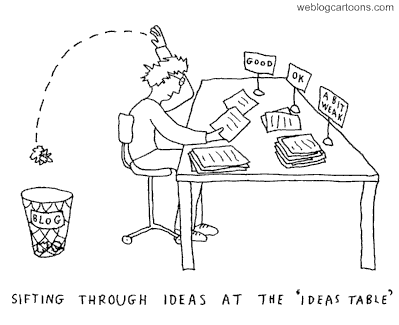
Image c/o <http://www.weblogcartoons.com/cartoons/sifting-through-ideas.gif>

Sometimes my blog ideas get filtered. I don’t always have time to write these thoughts out, so I often have to save this blog-worthy idea for later in my Delicious account, a WP draft post, or, most commonly, in WP, in a Gmail draft or Google Doc. During the crunch time of year, when all academic and professional deadlines seem to merge, my attention tends to drift. I find myself looking for interesting things to read and I seem to be more inspired to write blogs. I consider this digression to be a form of “productive procrastination.”

Inspired by the blog post from @InnovativeEdu, I thought I would share where I get my blog ideas from and what prompts me to blog:

  1. My regular online reading locations – I typically check my Google Reader, Twitter streams/hashtags, Google Alerts, social feeds, Percolate, and regular listservs/news feeds first thing in the morning. Sometimes there is a gem that I want to talk about in greater detail than just sharing it in a 140 tweet.
  2. Things I have to read “for school” – I am sure that no one is shocked to learn that you consume a hefty amount of reading while you’re a doctoral student. Beyond the “required reading” for class, I also stumble upon other finds when researching, compiling articles for my literature review and writing articles. Blogging helps me annotate and remember these theories, articles, and references in a synthesized portion to recall and use later.
  3. From conversations with peers & my PLN – I am fortunate to interact with a number of thoughtful and challenging peers on Facebook, Twitter, G-Chat, my campus, LinkedIn, Skype, and by phone. At least once a week (usually more often) I am fortunate to dialogue about something that makes me think and I want to write about in a blog to share
  4. Great finds for technology, learning ,and engagement I just want to share – Sharing – it was a good lesson I learned in kindergarten and have taken with me along the way.
  5. A photo or video that inspires me – I am a fairly active Flickr user, and  think that there are a great groups and community members that share visual inspirations that create a blogging spark. Lately Instagram, YouTube, Vimeo, and the odd infographic (there are too many of them now) have triggered ideas for blogging projects and shares.
  6. Professional & personal development opportunities – Whether it is a workshop on campus, a webinar online or an open learning session in the community, there are loads of ideas to reflect and bring back to my personal learning network (PLN).
  7. A question or request for advice – Sometimes I get an email, IM or call from individuals who want to talk about an issue or idea. When questions about technology in advising, education challenges, research process, or academic experience advice come up, I think how sharing this information in a blog post could be helpful to others who just have not asked.
  8. A Tweet – 140 characters shared on Twitter from either from me or someone else can inspire a blog draft. A tweet might include a quote, question, argument, Twitter chat, link, or random thought.
  9. Reading other posts & threaded comments – In reading a threaded discussion on someone’s blog, Facebook wall or open discussion in LinkedIn challenges me to consider my own perspective to later process it through a blog post.
  10. My own curiosity – If I want to learn more about a product, tool. vendor, process, or topic, I typically share what I have found on my blog.
  11. Contributions or things I produce – I document things I create for publications, podcasts, and presentations. Part of this is for my doctoral portfolio (ATPI is similar to the ECMP portfolio requirements, so I try to archive my work/experiences) and the other part is to share training and learning sessions. Why not put these ideas out there to extend to the audience that could not attend?
  12. Writing, writing and MORE writing – I write regularly. I started using 750words to keep me writing regularly to keep me writing. This activity helps weave my thoughts and develop new ones. Continuous writing allows me to practice my craft and improve how and what I write about.
  13. Cultivation of resources – My research interests vary and are interdisciplinary, so I collect a load of  resources – this could also be a direct result of #1, 2, 4, 6, & 8. Blogging helps me to  connect and process my thoughts to share with peers in these academic and professional fields.

I am sure there are other reasons, but those were the first few that came to my head. So the question for you is… what prompts YOU to blog? Please share.