CCK09, Learning Community

Networks Influence Learning

It’s know what you know, it’s who you know. Dave Cormier believes that “knowledge is something that can be negotiated and validated in a community of knowledge.” This means that the future of education may be more connected and less constructed. This idea both challenge and invigorates educators alike.

A couple weeks ago, Dave & Stephen discussed/bantered about a few key concepts about Connective Knowledge for CCK09 Week 4:

  • Knowledge is the psychological result of perception, learning and reasoning.
  • Connective learning is a process of creating new knowledge patterns.
  • Networks influence how knowledge is shared.

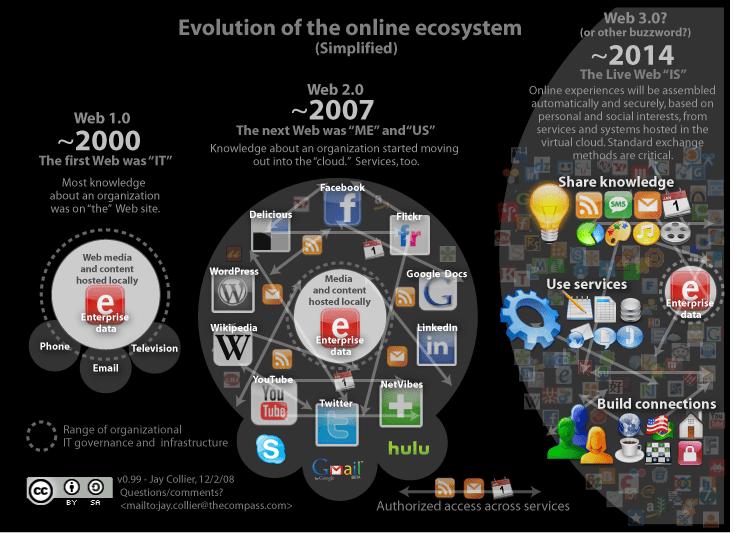
The Online Ecosystem (Redux) by Jay Collier provides a good example of how online connections have become more integrated over the last few years in higher education:
online-evolution

In thinking about how networks influence learning and how integrative online environments impact knowledge-sharing, Dave presents two camps for education practice for online learning:

1) The Guild Model: designed with rules & regulations, peer learners, and methods to validate success; no restrictions & not a fully connected model

2) The Wild West Model: learning & knowing by being connected to a group of people who do the same types of things that you do, i.e. through Twitter, blogs, etc; knowledge exists in random locations; natural kind of learning

Both models of learning have value for the online education, however one method structures networks from the instructor, whereas the other connections are organically grown by the learner. There are many examples of learning technologies and numerous tools to support online initiatives, however it is important to establish methods to make connections and best practices in developing skills for effective learning. As online connections and environments evolve, this debate for how to best construct online learning continues.

blogs, EC&I831, Learning Community

Blogging for Learning & Learning to Blog

I sat back to ponder why I blog, and why I take the time to read other blogs. Here are a few reasons I thought of off, the top of my head:

  • reflection
  • to share knowledge and resources
  • news & information acquisition
  • a research starting point
  • connection to peers in my field of study/work
  • a sounding board for ideas/questions/thoughts
  • to be part of a community

In thinking about education and reviewing the above list, I can see why blogging is an effective means for contextualizing and mentoring learners. Sue Waters mentors educators on effective blogging and web 2.0 resources on EduBlogs. She delved into the topic of blogging for learning and connection during last week’s #eci831 weekly session on Elluminate.  The concept of blogging in the classroom, leads to a transparent educational process for students. Learners are able to share ideas and be empowered in their digital learning community. Blogging can deeper understanding of knowledge and course content, while challenging students to participate in an open, expressive forum.

blogging

Image from the Algebra Learning Networking website 

It was interesting to learn how other students in the class viewed blogging for learning. Some are unsure about how to include blogs, while others want to ensure engagement and purpose in their learning environments. Here’s the #eci831 class brainstorm for our Thoughts, Challenges or Concerns about blogging:

    • how do educators best define learning outcomes to give purpose?
    • spam
    • how to get students to buy in
    • how to engage students; keep them interested and on task
    • most important aspect in my class
    • assigned topics or more creative original ideas
    • what to write
    • learning in a public forum – putting yourself out there
    • loosing the meaning for the learning objective
    • long term use
    • safety of students and liability
    • privacy concerns for parents
    • how to move teachers towards these ideas
    • non-standard views of students
    • open or closed environments for students?
    • teachers blogging as PD, nervous about putting their ideas out there
    • do all students feel confident in their posts
    • what to have the students blog about
    • how to move teachers away from seeing blogging as a tech ‘add

Final thoughts from Sue, was actually in the question form:

What are 3 questions (and why) you would like answered on educational blogging or building personal learning networks?

So here are my 3:

  1. What are some of the key privacy concerns for educational blogging? And how educators best address these issues? Resources for either Canada or US would be greatly appreciated.
  2. Are there any examples of peer mentor blogging initiatives in education, that you know of, in K-12 or Higher Education learning environments? It would be interesting to learn more about how modelling and mentoring can help learners engage in blogging.
  3. How has your blogging practice altered (or has it?) now that microblogging (Twitter, etc) has been introduced into the blogasphere? Do you engage much in microblogging? How do you see value in it for learning?


EC&I831, Learning Community

At The Root of Connectivism

Connectivism is a pedagogy that I have latched onto for the realm of learning technologies. This is a new learning theory for the digital age, and is further defined by George Siemens as:

  • Knowledge as constellation of connections
  • Sense-making/way-finding
  • Network (social/technological) as assistive cognitive agent
  • Technology as externalization/extension

It’s not the tools that are relevant, but rather the connections made while learning.

Siemens made a guest appearance in the EC&I 831 course last week to discuss The Roots of Connectivism.

A few of the major points that I took away from George’s presentation include:

  • Learning is networked at 3 levels:
    • Conceptual-Cognitive: least developed; when ideas & concepts are combined together
    • Neural: biological; memories being formed as a sequence of connections (encoding in the brain)
    • Social-external: social network analysis, often completed by sociologist; external tools and resources to connect learning
  • Knowledge & learning as networked and emergent through:
    • Synchronicity – to understand how a student will learn is to understand & connect with their current knowledge & awareness
    • Amplification – participatory sense making & interaction with material creates learning at a deeper level
    • Resonance – why do students start to tune into learning a concept or new information? how do they connect with an association?
  • Educators need to understand connections at a very basic level to best learn how to influence connections for learning
    • What connections are?
    • How they form?
    • What attributes/structure they exhibit at formation?
    • What various formations mean?
George left the class with a few questions to ponder:
  • What are the implications for educators?
  • How do we “teach differently” in networks than we do in a classroom?
  • How should our priorities change in skill development?
  • As the field of networked learning grows, where do we turn for guidance direction?

Educators need to assess learning objectives to help students develop in the changing digital world. Instruction is not just about knowledge comprehension, but will shift to focus on acquisition of information and learner networks. “Teaching differently” will be instructional practice that encourages learners to think critically and engage in complex activities for deeper learning experiences. Learners will be challenged to connect meaning and knowledge that is currently known, to that of their shifting paradigm.

As networked learning continues to change educational environments, educators must empower their students to adapt and grow with the technologies . It will be up to the educators of today to remain current and connected to practitioners and  innovators in education who are leading the way. Whether it is following a stream of ideas on Twitter, reading the latest literature/publications, continuing professional development, taking an open-source course, or sharing ideas with online colleagues, educators who stay socially connected will provide engaged learning opportunities.

My quest to be a “Network Sherpa” for learners continues….

What are you doing to help your Networked Student connect to their learning today?

Connectivism video created by Wendy Drexler’s high school students inspired from George Siemens’ CCK08 Class.

EC&I831, Learning Community, Social Media

What Are Your “Top Sites”?

Learning is social. Learning is connected. Learning is often informal.

The speaker this week in EC&I 831, Dr. Richard Schwier, discussed learning environments and encouraged us to reflect how we learn. He shared, with the class, how he consumes online content, and reflected that most of his online activity was social. In reviewing my own “Top Sites” in Safari I discovered that I too like to be social and connected online:

Top Sites

Here’s my quick list:

There is a lot of learning in my online life, and I definitely rely on my social connections and tools for support. While organization and structure help construct “formal” education, there is great value in spontaneous, chaos for informal learning. The key for learning is to engage and connect your students in the educational process.

A quote that resonated with me both as a learner and educator:

“We as educators need to reconsider our roles in students’ lives, to think of ourselves as connectors first and content experts second.” William Richardson

EC&I831, Learning Community

Open, Connected & Social With EC&I 831

The next online, open education course I am involved with this semester is EC&I 831: Social Media & Open Education from the University of Regina with Dr. Alec Couros that meets only every Tuesday evening (8-10pm CST). I first learned about this course through a few online networks in the ed tech arena, and I thought it may be an interesting lens to review curriculum and content development for learning. Here’s the 5 minute elevator pitch for the course:

The Tuesday evening elluminate session provided the basic introduction to the course schedule and outline. I am looking forward to connecting to other students to further explore the role of the educator/learner in terms of media literacy, knowledge and social networks.

It was great to hear the parallels between my personal philosophy of education, and how it ties into the learning objectives of this course.  Dr. Couros’ believes that there are great strengths in learning relationships and connectiveness amongst students, rather than just the specific content or knowledge.  It will be interesting to see how this sentiment is interpretted by the various weekly session speakers and participants throughout the course of the semester.

Although this course is similar to CCK09, I think that EC&I 831 will challenge me to:

  • get perspectives of social media education – history, ideas & development
  • expand my social learning theories & applications
  • experiment & play with NEW social learning & open educational tools/resources
  • provide a critical lens for curriculum development with social media & open education
  • build up my learning network – connect & enage with new online peers