BreakDrink, CTC, Higher Education, SAchat

Red Rover, Red Rover We Call Tom Krieglstein Right Over.

The Campus Tech podcast had a delightful chat with Tom Krieglstein last night. We learned about SUPERCAMP, startups, and the beginnings of #SAChat all within the latest CTC Podcast #13.

Photog from @tomkrieglstein

Tom shared with us how #SAChat was founded almost a year ago with the help @DebraSanborn. He shared with us the development and growth of The SA Collaborative, and how excited he was to watch it flourish with numerous Student Affairs professionals contributing, commenting and reading the regular blogs and contributing to the weekly #SAChat discussions on Twitter.

Tom discussed his development of Red Rover with @kprentiss. Red rover (as defined by the website) is “A simple web service that helps your students connect and contribute to their college community.” Tom is a big proponent for thinking about how we bring our students and communities together on campus. Although he claims to not be a dancer, Tom does believe that “dancing” together will help build community for our students.

Here’s how to dance with Tom (& on campus with your students):

  1. You have fun
  2. Meet people.
  3. Connect people to each other.
  4. Make small groups & then get out of the way.

Other Campus Tech News Bites & Information:

Kiva Adds Student Loans To Microlending Marketplace

Facebook Phone?

Google Docs Editing Coming to iPad and Android

Next Week’s Campus Tech Connection with @jacksonj, @jefflail & @laurapasquini = HOT TOPIC: Social Media Policy, Privacy & Issues on Campus

  • Does your school have a social media policy/guidelines? If so please send them to breakdrink@gmail.com
  • Question, comment or show idea? Leave a message or text us at 732-982-BREAK (7325)
  • Join us LIVE next Monday (9/27) at 7 pm CDT at BreakDrink Live, on Twitter with the hashtag #CTC and/or by calling in with a question [(646) 652-2342] during the program.

Higher Education, Learning Technologies

The E-Book & E-Reader Effect

Digital textbooks are an increasingly a more viable option for students. More college and university campuses are providing alternative options to a full-price, paid textbook. As textbook access options increase with rental and electronic format, learning resources become widely distributed to students.

In thinking about how I want to learn, I opted for 2 hard copy (and expensive) textbooks – as I thought there would be some value in keeping these two “on the shelf” for future reference. The other required books I borrowed or found copies online, and the remaining reading materials were online journals and articles. Surprisingly, I have yet to purchase an e-reader, nor do I own a tablet (yet), so much of my reading of the digital books are either on my computer at work, laptop at home or smartphone when in transit.

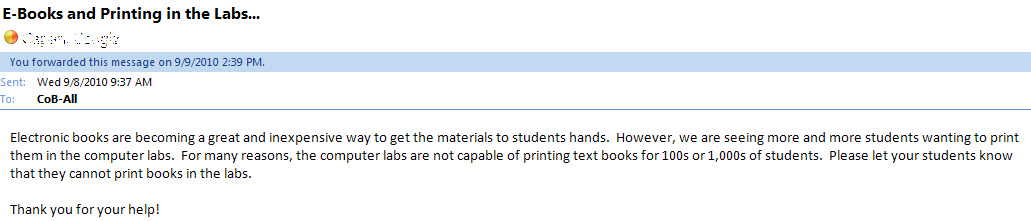
The head of the IT department sent us this e-mail last week, which got me interested and questioning e-books, e-readers and all things “e” for today’s student [click image below to view]:

This got me thinking –

  • How do students best learn with digital textbooks?
  • Does this shape the curriculum in higher education when textbooks are mandatory, and e-books are more accessible for financial reasons?
  • What is the success rate for students who study with e-books?
  • Why are students printing digital books?
  • What is the learning curve for reading e-books vs. printed texts?

Here are just a few articles and posts about e-books & e-readers which are helping me review my options for e-books in higher education:

Faculty/students/staff – Please share your thoughts on e-books, e-readers and digital textbooks in higher education.

Collaboration, Higher Education, K-12, Learning Community, Social Media

Social Media is Here to Stay

Just a reminder that social media is here to stay.  Pretty impressive clip about how social media and online use has evolved in the UK. It would be interesting to see how much social media is being consumed in North America. [REMOVE NOW]

And another classic Social Media Revolution video from 2009…

And recently from 2010…


Hey Educators – how are YOU taking advantage of social media in your learning environments? It’s just not for branding, advertising & selling. We need to utilize this form of media for education NOW.

AcAdv, BreakDrink, CTC, CTCX, Higher Education, Podcast

Campus Tech Connection in June

Is it just me or does summer seem busier than usual?

The Campus Tech Connection (CTC) radio show/podcast has continued to truck along throughout the month of June.  For those of you who have not been able to tune in live, you should play a little catch up during your summer travels or commute to the office.

Here are the latest & greatest shows straight from Campus Tech Connection June archives:

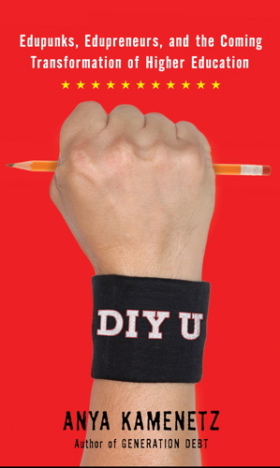
Anya Kamenetz, author of DIY U – June 14th CTC Podcast archived here

Eric Rank from Flatworld Knowledge – June 21st CTC Podcast archived here

Burck Smith from StraigherLine – June 28th CTC Podcast archived here

Join us tonight (Monday July, 12) on the Campus Tech Connection podcast with guest Erik Qualman, author of Socialnomics: How social media transforms the way we live and do business. Erik is also the Global Vice President of Online Marketing for EF Education.

Be sure to listen live here at 7 pm (CST) or check out the archived recording later when it is posted.

CTC, Higher Education, Open Education, Professional Development, SAchat

Take a Break with BreakDrink

BreakDrink was created by Jeff Jackson (a student affairs professional at San Antonio College) to provide the most current news and trends in student affairs.  This initiative was developed to share resources and information for best practices for higher education professionals.  During challenging economic times, this is an excellent way top provide online professional development and to connect a community for higher education practitioners.

The BreakDrink crew is always looking for help and support. If you have ideas, stories or innovative programs you care to share just send an email to breakdrink@gmail.com. Or if you want to check the current “jobs” be sure to visit the  jobs section of the website.

Recently I was asked to join in the BreakDrink fun by contributing to a new podcast series about technology on campus in student affairs & higher education with @jacksonj & @jefflail – called the Campus Tech Connection.

The Campus Tech Connection (CTC) podcast series’ goal is to help campus practitioners understand technology while becoming  active digital citizens. Through the blogtalkradio platform, we plan to bring on interesting guests that are engaged with the higher ed & technology realm every Monday night from 7-8 pm CST.  If you care to join in the fun to listen, you can do so and feel free to ask questions by calling in via phone/Skype to 646. 652.2342 or by tweeting questions by using the hashtag #CTC or #BreakDrink. We appreciate all comments, questions, thoughts and feedback from the listeners out there.

We kicked off the first CTC podcast with by interviewing Stian Haklev who is one of the co-Founders of Peer 2 Peer (P2P) University last night.  All of the CTC podcasts will be posted on BreakDrink.com under the Tech section of the website, but I will be sure to post comments & thoughts each week as on my blog as well.

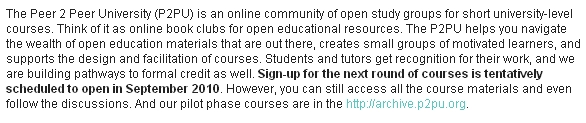
In talking with Stian we learned a great deal about the P2P University model beyond the initial blurb on the website:

Stian has posted the podcast on his blog, however some of the key points that interested me most have to do with the model of open education and how this concept can (and will) impact learners around the globe.

It will be interesting to see how this P2P U model will evolve beyond their one year of funding from the Hewlett group and Shuttleworth Foundation fellowship. It seems like a great deal of open education faculty/programs (#oer #ocw) like MIT Open Courseware, Open Ed at UBC and others are greatly involved in this project.

P2P U encourages learners and faculty alike to join in these participatory communities to share, connect, and learn. This group is really thinking about the bigger picture, and what learning will look like in the future with the sole purpose to engage others in online learning.  The plan is to continue P2P University course delivery through the support of donations, university partnerships and encouraging higher ed institutions to purchase access to their educational platform/services for instruction. I plan to stay tuned in to see what unfolds with the Peer 2 Peer University, and perhaps I’ll either pick up an online course for my PhD (for independent study or just self-interest) and/or propose a course of my own down the road.