
#AcWri, #phdchat, Book Review, LPQ, Social Media

Book Review: Social Media for Educators #summerreading

After reading, Social Media for Educators by Tanya Joosten (a.k.a. @tjoosten), I decided to complete an #AcWri book review in the Learning and Performance Quarterly 1(2). Since this journal is online and open access, I thought I would blog a few key ideas and highlights from this #summerreading book. Book Review: Social Media for Educators [PDF]

Abstract: Social Media for Educators is an excellent book that interweaves theory, applications, and current pedagogical experiences for learning environments. For those in the learning and performance industry, this book provides insights and ideas to help guide social media use for both educators and learners. Joosten provides current examples, benefits, and considerations throughout each chapter. Whether educators are beginning to design their learning curriculum or learners are considering social media for organizational development, this book presents helpful insights and experiences that will potentially influence and shape effective engagement and learning with social media.

Keywords: Social Media, Education, Strategies, Practices Although I have previously blogged about strategies for developing social media guidelines — I thought I’d share a few other suggestions for social media engagement from the book. Here are a few ideas, but really I would just recommend reading the book if you’re interested in social media for learning, training or development.
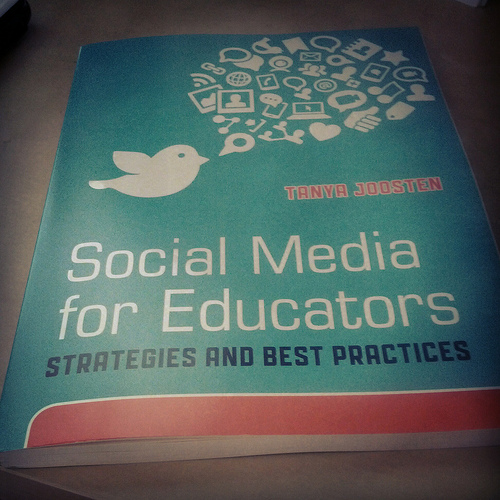
Part One: Background I appreciate how Tanya Joosten lays out the history and evolution of what we now know as social media. Social media is defined by a number of educators and summarized as “A virtual place where people share; everybody and anybody can share anything anywhere anytime” (Joosten, 2012, p. 6). Social media encompasses Web 2.0 tools, social networking sites, and user-generated content where individuals engage and contribute to these digital spaces. This section introduces readers to how social media is being used to build a network, establish support systems, and grow relationships among peers. There are a number of examples where professionals can “get their feet wet” for using social media for professional/personal use. Finally, this section wraps up with implementation considerations and identifying the following pedagogical needs (Joosten, 2012, p. 30):

  1. Increasing communication and contact
  2. Engaging students through rich, current media
  3. Gathering and providing feedback
  4. Creating cooperative and collaborative learning opportunities
  5. Providing experiential learning opportunities

Part Two: Social Media: What to Do With It? I enjoyed how this section of the book presented practical case studies and useful ideas for social media communication and instructional design. The examples and “how to” guides for using social media are very helpful when considering how to enhance the learning environment. Many of these examples are excellent models for various types of learning experiences (in class, online, blended, etc.) and training opportunities (professional associations, affiliations, etc.). As an instructor/student, I agree with Joosten’s thoughts on how social media helps facilitate peer instruction and greater interactions. I also agree that social media features and characteristics often provide a richer learning experience (Joosten, 2012, p. 54), including:

  1. Provides a virtual space for storing, archiving, and retrieving
  2. Facilitates rich and current information
  3. Increases the ability to aggregate resources to share
  4. Offers immediate access to information through mobile apps or through RSS feeds

Part Three: Other Considerations in Implementation The last section of this book deals issues that often accompany social media in education, including policy, administrative and IT support, cost, user-generated media, support for educators, training needs, effective evaluation practices, and challenges for implementation and use. The last few chapters guides educators on how to go forth and create their own social media instructional plan at their home institution. Dr. Joosten provides evaluation instruments, suggestions for establishing learning outcomes, and assessment ideas for using social media in education.

References

Joosten, T. (2012). Social media for educators. San Francisco, CA: Wiley/Jossey-Bass.

Pasquini, L. A. (2012). Book review: Social media for educators. Learning and Performance Quarterly, 1(2); 83-84.


#AcWri, LPQ

Learning and Performance Quarterly, 1(2) is Published

As the founding student editor for the Learning and Performance Quarterly, an open, online peer reviewed journal, I am excited to share with you the second issue. This publication has an eclectic mix of ideas and research for a wide array of academic disciplines in the learning, training, development and performance industries. As, indicated in my editorial, I think that there is great value to be shared outside of our professional silos.

I hope that you enjoy reading this issue as much as I did during the production phase. There are a number of concepts and resources shared within these articles for professionals in education, instruction, leadership planning, and training and development. Many thanks to the contributing authors, peer reviewers and section editors who made great efforts to produce this publication over the summer months. I appreciate the attention to details and edits during the summer months.

For those who want to contribute, review, or follow along — be sure to check out the LPQ Website, Follow @LPQuarterly on Twitter, or “Like” the LPQuarterly on Facebook. We are always interested in adding to our repertoire of peer reviewers and editors – please register for the LPQ journal and let us know how you would like to contribute to this open, scholarly publication.

Here is the Learning and Performance QuarterlyVol 1, No 2 (2012) — Table of Contents and Abstracts for the current journal contributions.

Editorial
Leadership, Training, Mentoring, and Instructional Design (1) [PDF]
Laura A. Pasquini

Abstract: The second issue of the Learning and Performance Quarterly (LPQ) is filled with submissions that span a wide scope of interests.

Case Studies
Developing a student leadership retreat using instructional design
techniques (2-29) [PDF]
Dr. Melissa L. Johnson

Abstract: The purpose of this paper is to describe how the Morrison, Ross, and Kemp (2007) instructional design model was used to design a student leadership retreat. An overview of instructional design and the Morrison, et al. model is provided. The application of the model to designing the retreat is then described in detail, including the learner and task analysis, development of instructional objectives, sequencing and materials, and formative evaluation. Finally, the implementation of the actual retreat, including summative evaluation procedures is provided.
Research Articles
Mentoring and Middle School Teachers: Using Subjective Affective Measures as
Performance Indicators (30-46) [PDF]
Dr. Ray K. Haynes

Abstract: This paper presents findings from a research study examining mentoring, organizational commitment, work alienation, and job satisfaction, among middle school teachers (n = 352) in large urban school district. Survey data obtained using a quantitative research design suggest that  formal and informal mentoring is occurring within middle schools and middle school teachers perceive both types of mentoring to be effective. Results of regression analyses suggest that ratings of formal mentoring effectiveness had stronger relationships to organizational commitment, work alienation, and job satisfaction than effectiveness ratings of informal mentoring.   Further analysis suggests that the predictor variable, as measured by ratings of mentoring (formal /informal) effectiveness, had statistically significant positive associations with the mediator and dependent variables. Implications are discussed along with suggestions for future research.

Concept/Theory Paper
Cross cultural training and success versus failure of expatriates (47-62) [PDF]
Ashwini Esther Joshua-Gojer
Abstract: The past few decades has seen an explosion in research on expatriates and cross-cultural training. There has been controversy and an unending debate on the goals, effectiveness, implementation and processes of CCT. There are very few reviews that have condensed literature detailing the best practices of CCT. This review also details the success and failure of expatriates. The antecedents or moderators that play a role in the evaluation of success and failure have been outlined in this literature review. It also brings to light certain solutions that will make CCT more effective and provides directions for future research.

Creative Leadership: Does It Clash Across Cultures? (63-82) [PDF]
Seogjoo Hwang
Abstract: As international competition, technology advancement, and the knowledge-based economy increases, creativity is becoming increasingly critical for the success of organizations all around the world. While leadership or support of individuals’ immediate leaders is one of the most potent factors impacting individual creativity, the majority of previous studies examining the relationship between leadership and creativity were conducted in Western contexts and only few studies investigated the cross-cultural aspects of leadership and creativity.

This study explores the connection between traditional creativity research and cross-cultural leadership research, building toward a conceptual framework proposed for further discussion and ultimately testing. Conceptual links between participative leader behaviors, individualism-collectivism, power distance, and creativity are examined. Implications for leadership development in order to enhance organizational creativity in an international HRD context bring this article to a close.

Book Review
Social Media for Educators (83-84) [PDF]
Laura A. Pasquini

Abstract: Social Media for Educators is an excellent book that interweaves theory, applications, and current pedagogical experiences for learning environments. For those in the learning and performance industry, this book provides insights and ideas to help guide social media use for both educators and learners. Joosten provides current examples, benefits, and considerations throughout each chapter. Whether educators are beginning to design their learning curriculum or learners are considering social media for organizational development, this book presents helpful insights and experiences that will potentially influence and shape effective engagement and learning with social media.

AcAdv, Career, UGST1000

Open Options: Choosing a Major With Road Trip Nation

With first year students, there are many new, exciting and scary things about starting college or university. Higher education offers a place to be intellectually challenged, develop socially, discover your interests, and engage with a variety of opportunities on campus and beyond. The road and journey are both wide open. The open road and the growing number of academic/career possibilities seems to be a bigger challenge to our student population. Besides the confusion of campus jargon and the navigation of a larger than high school institution, there seems to be more students and family members at orientation who are anxious about making the “right decisions now” for later. Many higher ed students have an idea or inkling of what they want to do, but most are not sure about their academic options, career path planning, and helpful resources to support their decision-making process.

For UNT students who enter into the undecided/undeclared program at UNT, the Office for Exploring Majors [where I work] utilizes the Roadtrip Nation (RTN) resources and has a  RTN project as part of the UGST 1000 – First Year Seminar class.

The Open Road for #UGST1000 Course Design The RTN project helps students explore their personal, academic, and career path. More importantly, it allows them to learn that there is more than one path to obtain their goals and dreams. In picking up  Roadtrip Nation: A Guide to Discovering Your Path in Life and Finding the Open Road: A Guide to Self-Construction Rather Than Mass Production – I was reminded about my own academic/career journey and questions I had in undergrad and after. There are a number of different professional journeys and narratives that provide readers a “path” of how to get to where you want to go.

Overall, I will be using Finding the Open Road stories and interviews (posted online) to help expose the pre-Journalism (News, Advertising, Strategic Communication & PR) and pre-Business (Entrepreneurship, Marketing, Management) students in UGST 1000 figure out how to navigate their own experience. I do like the strategies and ideas in the “Do It Yourself” section of the Roadtrip Nation book to help guide our students learning. The plan is to take the follow chapters and make them into easy-to-use guides for both the UGST 1000 instructors and students that follows the Roadtrip Nation Manifesto:

  1. First, Find Your Red Rubber Ball – What inspires you? What is your passion? Identifying interests, values, and likes.
  2. Whom Should You Meet? – tips on how to find people, being resourceful, using your personal network, how to reach out to new people
  3. Getting the Meeting – cold calls, the pitch, being persistent, communication strategies
  4. Preparing for the Interview – researching the person, their company, their work experience
  5. In the Meeting – what to talk about, suggested questions, informational interview samples, interview/meeting etiquette
  6. Closing – ending a meeting, sending thanks, developing a mentoring relationship

RTN asks....

References:

Marriner, M. & Gebhard, N. (2006). Roadtrip Nation: A guide to discovering your path in life. New York: Ballentine Books.

Marriner, M., McAllister, B. & Gebhard, N. (2005). Finding the open road: A guide to self-construction rather than mass production. Berkeley, CA: Ten Speed Press.