
While working on some late night treadmill mileage, I decided to catch up on documents and books I have been collecting on my Kindle. Last week I read The Future of Learning Institutions in a Digital Age, which was a precursor to The Future of Thinking: Learning Institutions in a Digital Age book published by the John D. and Catherine T. MacArthur Foundation. Although this material is a bit dated, I think that some of the pedagogy still applies for educational development.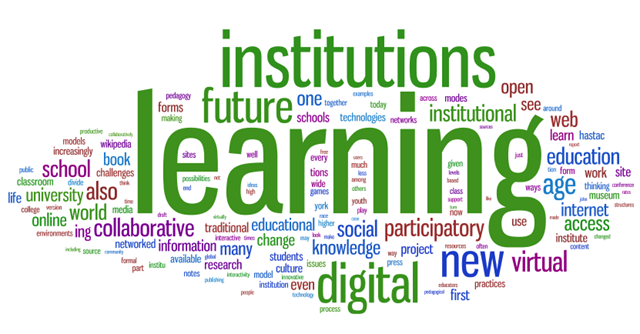
Image c/o Martin Hawksey (and his musings on this text as well).
In the first collaborative project, the authors share ten principles to support the future of learning. Davidson and Goldberg (2009) presented these pillars of institutional pedagogy to help institutions rethink learning and meet the challenges that lie ahead for both K-12 and higher education:
- Self-Learning – discovering and exploring online possibilities
- Horizontal Structures – how learning institutions enable learning; from learning that to learning how; from content to process
- From Presumed Authority to Collective Credibility – shifting issues of authority to issues of credibility; understand how to make wise choices
- A De-Centered Pedagogy – adopt a more inductive, collective learning that takes advantage of our era and digital resources
- Networked Learning – socially networked collaborative learning stressing cooperation, interactivity, mutuality and social engagement
- Open Source Education – seeks to share openly and freely in the creation of culture and learning; provides a more collective model of interchange
- Learning as Connectivity and Interactivity – digital connection and interaction to produce sustainable, scaffolding ensembles
- Lifelong Learning – there is no finality to learning; learning is part of society and culture
- Learning Institutions as Mobilizing Networks – networks enable flexibility, interactivity, and outcome; new institutional organizations reliability and innovation
- Flexible Scalability and Simulation – new technologies allow for collaboration beyond distance or scale for productive interactions that warrant educational merit
Reference: Davidson, C.N. & Goldberg, D.T. (2009). The future of learning institutions in a digital age. Cambridge, MA: The MIT Press.

 techKNOWtools
You must be logged in to post a comment.