BreakDrink, CTCX, Higher Education, Learning Technologies, Social Media

Will Google+ Be a Plus for Our Learners?

At the end of June, the @BreakDrink Campus Tech Connection (#CTCX) discussed Google’s new Chromebook hardware and some of it’s applications on our show. Here is a great as walk-through of the Samsung 5 Chromebook c/o our listener @brifanning and his co-worker Vlad.

As a student who primarily reads, researches, writes and works online for both classes and in Google applications – the Samsung 5 Chromebook is a good fit for my needs. I like the portability, access to both 3G/Wifi and most of my content is stored online which requires me to have little to no memory space. I still have a my MacBook Pro to support final manuscript edits, listen to my iTunes library, Skype with far away family/friends and so on. This means that my Chromebook is NOT replacing my current computing needs entirely; however it does help me as a full time professional and student as I work on a Mac at home, PC at my office and fulfill my lightweight need for classes/research on campus. A ReadWriteWeb article said it best: It’s not the device itself that matters, it’s how you use it. 

In considering the value of either a Chromebook or netbook for higher education, I can see why some institutions might head for the clouds. Many organizations are finding it far easier, less expensive and more efficient to access resources in the cloud. As budgets are cut and resources shrink, many institutions will consider integrated systems that support the changing IT needs for education.

Here are a few ways higher education professionals could put a Google Chromebook to work on campus:

All things Google (Chromebook, OS, Apps & Plus) is becoming more appealing to educators. Although many features are still in beta mode and integration has been limited between Google products and now Google+ – there is potential to connect and share with learners in this new social space. 
What impact will Google+ have on education and learning? I doubt that Google Plus will replace the enterprise or LMS systems supported by your higher ed institutions just yet; however it could be a great solution for instructors who are searching for alternative learning environments/platforms. Although it is fun to speculate the learning possibilities of Google+, I would be more interested in piloting a course or training program using this social web first. I plan to explore the features it has to offer & find out what new additions are ahead before identifying Google+ as a learning and training tool. Google+ has the potential to support groups for training, development and on-going learning initiatives. There is much to be said about a connected community of online learners who are interested in sharing and engaging. It will be interesting to see what updates Google+ is working on and what happens as otheres flock to the social network to explore.
In the meantime, here are some preliminary thoughts we recently shared on the #CTCX Google+ Preview Show from last week, and the BreakDrink Google+ Overview & Resources Guide for those of you just exploring the Google+ realm.  Please share any resources & links you find about Google+ In the LIVE Google Doc. Thanks!

What do YOU think about Google+so far? Is is a plus for you or for learners?

eduMOOC, Learning Community, Open Education, PLN, Virtual Communities

Online Learning Today with #eduMOOC

Last week, the #eduMOOC course with over 2, 500 participants located in over 60 countries participated in the first session topic Online Learning Today for the Online Learning Today… and Tomorrow course.
I will be honest – the massive, open and online courses format will not be taking first year undergraduate courses by storm. Many of my incoming students are concerned with transition from high school to higher education, and often stay clear of online courses in their first semester. In contrast, as a graduate student and self-proclaimed life-long learner, I like the autonomy and independence a MOOC has to offer. I like to connect, share and learn informally with others, so this is probably why I signed up for the course.  The first week’s session (Thursday 1-2 pm CT) was recorded and the PDF slides were archived for those who could not attend the live session. Here are a few key questions and ideas discussed from the panel:

Who do we serve in online learning today?

Online learning has typically met the needs of our non-traditional learners; however with the impacts and growth in emerging technology for education online learning is becoming a staple at most higher education institutions. As we are encouraged to “do more with less,” online learning is now required to meet the continuum of learners and learning pedagogues are not quite developed for many campus learning environments. Although online learning is just another dimension of learning, more higher education technology leaders need to identify methods for effective design and high-quality curriculum delivery.

Is the nature of how we learn changing? How? Why?

Both the learners and learner environments have evolved over the past 30 years. The delivery, medium, and evaluation of learning has impacted today’s higher education classroom. Emerging methods of curriculum execution and faculty instruction are beginning to increase learner engagement beyond our campuses. Online learning allows for fluid participation and continuous experiences. Learning has always been social; however new mediums now increase our learning networks across the globe and enhanced how learning objectives are reached.  

In order to meet the needs of global learners in higher education, more institutions will have to move forward with technology or be left behind. Other questions that were discussed by the panel include: 

  • How do for-profit vs. not for profit higher education institutions impact online learning? 
  • We may have one the access war, but have we won the accessibility war with online learning?
  • Are we considering universal design for learning
  • Is there still cannibalization of online learning? Disrupting College http://t.co/Jg8egj0 via @amprog
  • How are faculty, instruction & evaluations designed to review impacts for online learning?
  • What are the challenges for online learning today in 2011?
Captain Obvious point: Online learning is growing and many institutions are behind in their development and support for this type of learning. This fact is apparent. Take a look at most higher education course offerings online and how these courses are designed. Online learning IS growing, in terms of, demand, quality, global reach, resources, and access. What I am more interested is HOW higher education institutions will meet the demand of online learning? Institutions are currently struggling with decreased budgets, low enrollment numbers and maintaining staffing needs to support our student populations – just to name a few challenges.
 
In reflecting about the session, I can not say that I came away from it learning a whole lot of new ideas – more these questions will shape what lies ahead in this course for the weeks to come. I was sort of disappointed that the panel did not represent any global educational leaders in the #edtech field as planned – but hopefully this will change in future sessions. And I did take note of the debates around the actual value of this #eduMOOC and other MOOCs for education and learning in a few blogs, Twitter and other online entities of the social web – which also has contributed to my learning. 

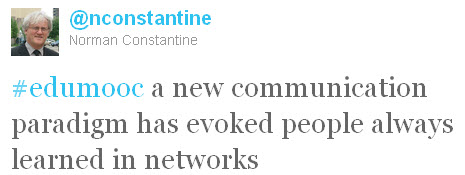
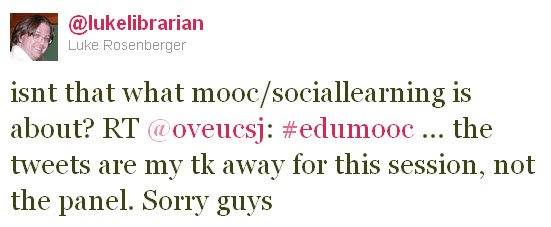
It’s this sort of discourse that most challenges me to think and really, a MOOC is similar to a personal learning network and what you decide to make of it. As a seasoned-learner, I find great value in on-going discourse that occurs on the #eduMOOC backchannel on Twitter, on the eduMOOC Fb group or just reading blog posts that share ideas and resources about the course topics. I encourage others to engage by following a few key hashtags [#onlinelearning #eduMOOC #elearning] and start a dialogue with your classmates. I still think the best types of learning from MOOCs comes from the community of learners and those participating in the learning network. As it was said best:

BreakDrink, CTCX, Learning Technologies, web 2.0

Nothing But Web

There are a systems of systems being created. Our data is detected to help up be more efficient and effective at what we do. An interesting video was released from IBM Social Media called The Internet of Things. This video looks at the complex set of relationships among all of these complex systems to see patterns in the data, information and knowledge to support innovation.

Google took great consideration in thinking about how they complex systems apply to the webapplications and extensions, as shared on the Google Channel. In considering how we work, play and interact online – the evolution of Google’s Chromebook appeared mid-June to support this online user. The Chromebook is a new alternative to using a notebook interact and engage online using new features & the Chrome OS. Here’s a quick synopsis via @googlechrome

Join us on Monday (6/27) at 7 pm CT as the BreakDrink Campus Tech Connection (#CTCX) talks LIVE about the Chromebook Samsung 5 and more tech tools reviews for higher education professionals. Join the #CTCX gang with your thoughts, questions, ideas or reviews: 

  • Listen to the show LIVE
  • Tweet your thoughts using the hashtag #CTCX 
  • Call or Skype during the show: (646) 652-2342 or breakdrink
CCK09, EC&I831, eduMOOC, Learning Community, Professional Development, Virtual Communities

What’s A MOOC?

What is a MOOC? What it is not = 


Flickr photos c/o maraker & cobalt123

Many of my educational technology peers might have heard the term MOOC tossed around before. For those of you who are just hearing this acronym, let me further explain. MOOC = Massive Open Online Course. It is exactly as the title describes. Here is a further description from Jan Schwartz‘s article – Learnings from a MOOC:

In the MOOC, the facilitators aggregated the conversations on a daily basis via a mass email, took a few really good posts (in their opinion), and advanced the conversation by asking more questions and pointing the discussions in relevant directions. Their choice of good posts included both the pro and the con of topics of connectivism and connected learning. 

The term MOOC was recently shared in yesterday’s Wired Chronicle article . When I heard about this upcoming MOOC last week I was looking forward to this course. My past experiences in other MOOCs – EC&I 831 & CCK09 – have contributed to my professional development, academic research and personal learning networks.  As an on-going learner, MOOCs often cultivate my learning interests and challenge me to go beyond what I  learning realms.

The Center for Online Learning, Research and Service at the University of Illinois Springfield is currently welcoming participants to their upcoming eight-week MOOC starting on June 27, 2011. [You can follow @edumooc or the hashtag #edumooc on Twitter and check out the eduMOOC wiki if you just care to “lurk & learn”]:

Online Learning Today…and Tomorrow

This collaborative course is completely open and free. Check out the great schedule for weekly panel discussions with experts in field. This will be a fun learning opportunity for some and perhaps great professional development for others.  I also encourage you to check out Dave Cormier‘s videos that shares  “What is a MOOC?” and how to be successful in a MOOC:

astd, Learning Technologies, PLN, Professional Development, Social Media, Training

How Does Your Social Learning Garden Grow?

It is important to consider how your organization uses the social web for learning professionals. The American Society for Training & Development (ASTD) recently published INFOLINE: Social Learning for Learning Professionals initiated a review of social media engagement beyond knowledge workers (educators). Social learning is not competing with formal education, training, or employee development; instead it is a space to connect professionals and share ideas. Although social media learning is often compared to informal or e-learning, it distinguishes itself as learners search content, develop interpersonal engagements, and form shared communities of practice. 

The key Social Learning Technologies include:

  • Online Communities – personal learning networks & virtual learning environments
  • Media Sharing – sharing & tagging videos, images, photos and more!
  • Microsharing – 140 characters to highlight news, share trends, ask questions & link URLs
  • Collaboration Tools – wikis, shared documents & cloud computing platforms
  • Immersive Environments – virtual worlds, gaming, augmented reality & simulations
  • Social Learning at Events – IRL meetings to connect offline for shared interests & goals

More professionals value social media tools to enhance communication, improve knowledge sharing, find resources and connect to a broader learning network. Many social resources create a space to solve problems, mentor employees, scaffold training initiatives and support effective decision-making. Organizations that support social learning may not see traditional return-on-investment (ROI); however they do have the potential to enhance the following items in its organizational culture:

  • retaining institutional knowledge
  • attracting and retaining professionals
  • succession planning
  • connecting dispersed employees
  • collaboration to solve problems
  • integrated & holistic approach for staff development
Social learning groups are sometimes organic, and others are intentionally created with specific learning goals. Any organization interested utilizing social media in a training and development program might want to consider a few guidelines before proposing to the idea the senior leaders:
  1. Establish a purpose.
  2. Encourage participation.
  3. Encourage respectful communication.
  4. Identify a gardener.
  5. Outline limitations.
  6. Include troubleshooting information.
Reference:
Bingham, T. (2011, January). INFOLINE: Social Learning for Learning Professionals. ASTD Press, 1101, 1-16.