Higher Education, Networked Community, networkedscholar, Reflections, Research

Thinking About My Networked Self & Digital Experiences In Higher Ed

This past summer, I spent a great deal of time talking to colleagues in higher ed to learn how they utilize social media to connect with peers and support one another in online communities. These interviews and conversations have been enlightening to help us understand more about how our digital, networked selves come to work on a university/college campus and contribute to our professional fields. For some, it is becoming increasingly vital to share instruction, scholarship, and practice online.  For others, there are still concerns about being connected to colleagues as our social networks now have context collapse. In the online world, what IS really private vs. public? Which networks are used for personal and/or professional practice?Open and digital channels help higher ed faculty and stuff in a number of different ways: asking/giving advice, collaboration on projects, free professional development, sharing information/resources, colleagues solicit advice, personal/professional support, and opportunities to learn in digital communities with common interests. Besides developing a digital presence or a “persona” online, higher education staff, administrators and scholars are utilizing social media and digital technologies to support their work, add to their professional development, engage with peers, learn in the collective and publicly in digital spaces and places.
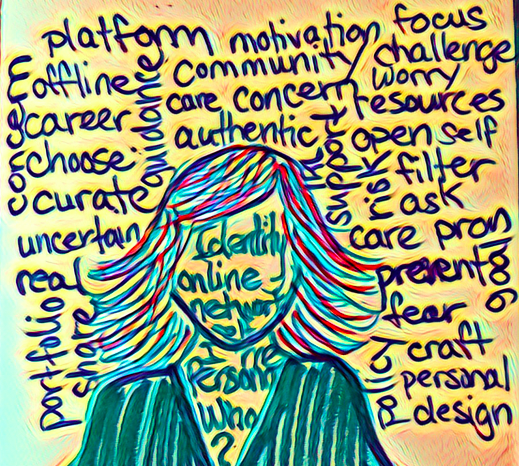
This leads me to ask these questions of my peers working in higher ed:

  • How does being part of a digital learning network support your professional learning and development?
  • How are you shaping your online identity and presence to share your professional values?
  • How can networked communities expand your knowledge and learning to enhance your role on campus and the work you do?
  • Why might others consider finding networked peers and practitioners to scaffold their own career goals?

Although there are benefits to “working out loud” and online, there are also a number of issues as we repurpose social, digital spaces. The stakes are high, as an increasing number of higher ed professionals participate in online social networks with minimal institutional guidance for sociotechnical support or training (Pasquini & Evangelopoulos, 2017). Social and digital networks are connected, public and scaled — and often not on spaces we own or have control over. Additionally, much of our own data is being collected and reused on these networked platforms. This has me wondering:

  • How are higher ed staff and faculty evaluating their online participation on these social networks?
  • How has their contribution to open, public spaces shifted over the years?
  • What does being online as a higher ed professional look like now?

These are just a few of the questions we are asking in our research study. If you are interested in sharing more about your own experiences as a professional in higher ed, please consider contributing by participating in an interview (more about the study here).

Research Interview Sign Up: http://bit.ly/networkedself

Part of this blog post is cross-posted via my Inside Higher Ed Digital Learning opinion piece.
Learning, Performance, PLN, Professional Development, Reflections, TBT Posts

Ode to Hashtag

Dear Hashtag,

I am SO sorry I missed your 10th birthday. With the start of the new academic term and a number of paper deadlines, my attention was elsewhere. I know. No excuse, right? But, can you please forgive me? Wait — I know how to make these belated wishes better!

To honor your decade of existence on social media and everyday conversation,  I decided to get creative with your birthday gift. I am truly grateful for the communities you unite, the awareness you share, the conversations you thread, and the subtle way I can give my tweets/posts/texts more meaning.

Ode To Hashtag

Hashtag, hashtag

We adore thee

Signal events and,

Tags for news

Tweets unfold like stories before thee

Link us to interests we so choose

Twitter chats used for work and play,

Say so much in just one little tweet.

Symbol of meaning is here to stay

Pound sign in speech is hashtag sweet!


Tweeters unite in hashtag chorus

140 characters: “Trends for you”

Blue bird, Larry, is tweeting o’er us,

Hashtag use connects us too.

Post composing, humor we’re sharing

Ideas in the midst of memes,

Protest tweets or GIFs of caring

Hashtags filter social streams.

Thank you for all that and all you have done this past decade.  You have contributed so much more to my life than I can ever thank you for — keep up the great work!

Your friend,

Laura

p.s. Here are a few throwback posts where I give you an honorable mention, as well. A toast to you! #cheers

MOOC, Online Learning, Reflections

The Student Story in Open, Online Learning

In starting a new year and a new term, I am thinking more about student stories and learner experiences in my courses. From my teaching in K-12 and now in higher ed, I continually strive to be a “good teacher.” We know that quality education comes from instructors who are reaching students and by improving learning design, delivery, and engagement. There are multiple intervals during an academic term where I stop to reflect on the lessons learned in online education and to think about my own instructional practice.

Like a number other instructors in higher ed, I review learner comments from the course evaluations at the end of the term. Beyond the evaluative score of these instruments, I think it is critical for instructors, learning designers, researchers, and administrators to listen to the student story in our online (and open) learning environments. Additionally, I solicit student my own student feedback at the beginning and end of the term to learn more about their goals and individual experiences. I also take short notes about each course assignment, project, discussion board prompt, or journal entry reflection to remind myself of how students engaged with/learned from these activities. Much of my instructional reflection involves pedagogical considerations, rather than technological applications. I want to encourage my learners to persist, so I offer opportunities to improve with draft assignments and provide on-going feedback/follow-up. In thinking about my communication practices and technological tools, I want to ensure my online classroom is interactive and offers opportunities to meet both the learning outcomes and student needs.

open_learner_stories

What do students really want from their online instructor? Here are a few things I have learned over the past few years of online teaching:

  • Provide a purpose of each course section connected to the learning goals
  • Easy to follow course design and navigation for online learning
  • Transparent expectations for requirements and how they will be evaluated/assessed
  • Clear directions for course assignments, projects, and activities
  • Meaningful online activities and projects that apply beyond the course or connected to their own career/academic goals – relevance!
  • Relatively quick responses to questions and/or communication standards as to when/how the instructor/TA for course support
  • A connection to the instructor via  “presence” or involvement in the course, e.g. video lectures, lecture/screencasting, audio files, course discussion participation, etc. to make it personal and meaningful

As I research online learning strategies to succeed, and continue to teach online each semester, I really want to know more about how my learners persist in online — so I can improve my own practice. In George Veletsianos‘ (2013) book, Learner Experiences with MOOCs and Open Online Learning, ten graduate students immerse themselves in open online learning experiences for two months and share their own narratives. This collection of peer-reviewed, learner essays offer further insight and reflection on the following questions:

  • What are learner experiences with open online courses, MOOCs, and other forms of open online learning?
  • What is it like to participate in open online learning?
  • What are learners’ perspectives of MOOCs?

Although I am not instructing a MOOC, this free e-book offered suggestions to improve learning delivery/design and identify ways to scaffold online environments for my own students.  This book may only a slice of online learning, as it shares learners’ reflections from MOOCs, it does indicate that distance education is a complex thing. Expectations, realities, and execution of this learning is quite varied.  I think these narratives provided by graduate students offer insight into distance education itself, and perhaps, how we even approach research in this arena. These student stories reminded me to involve my learners in the process of understanding their educational experience. When it comes to online learning, we should ensure the student voice is not crowded out by research ABOUT our students, that is, we need to think about research BY our students. I am thinking more about this key point as I contemplate how to best involve my sample population’s “voice” in my research and discover meaning further meaning that is often overlooked in scholarship.

Reference:

Veletsianos, G. (2013). Learner Experiences with MOOCs and Open Online Learning. Madison, WI: Hybrid Pedagogy Press.

#3Wedu, Reflections

#WINEvent and Corking 2016 with #3Wedu

This month, I have been dropping knowledge about savory red wines with Fiachra as we dive into our self-stocked Wine (Ad)vent calendar (this one was sold out). Each day leading up to December 25th, our household is celebrating the end of 2016 by unwrapping a bottle of vino for #WINEvent. Each wine was selected with a particular story in mind, and we share this tale and our thoughts the wine selection with each other (and sometimes friends who drop in). Want to learn more about the bottles sampled? Check out our 2016 #WINEvent Flickr album or listen to our daily stories/wine reviews via SoundCloud. It’s our way to send off and put a cork in 2016, as we’re sort of done with this year.

corkit

Do you know who is also OVER 2016? The #3Wedu ladies! Join us as we put a cork in 2016 with our final podcast on Wednesday, December 14th at 3 pm PST // 5 pm CDT // 6pm EST.  Episode No. 12 may offer a few reflections, NO regrets, and our future musings  for the Women Who Wine in Edu. Join us for the candid conversations and, as always, BYO-Wine (or festive beverage of choice)! We are looking forward to chat and cheers with you to send off 2016, and discuss what lies ahead for the new year. Come join the banter and comradery here: