Higher Education, Learning Technologies

The E-Book & E-Reader Effect

Digital textbooks are an increasingly a more viable option for students. More college and university campuses are providing alternative options to a full-price, paid textbook. As textbook access options increase with rental and electronic format, learning resources become widely distributed to students.

In thinking about how I want to learn, I opted for 2 hard copy (and expensive) textbooks – as I thought there would be some value in keeping these two “on the shelf” for future reference. The other required books I borrowed or found copies online, and the remaining reading materials were online journals and articles. Surprisingly, I have yet to purchase an e-reader, nor do I own a tablet (yet), so much of my reading of the digital books are either on my computer at work, laptop at home or smartphone when in transit.

The head of the IT department sent us this e-mail last week, which got me interested and questioning e-books, e-readers and all things “e” for today’s student [click image below to view]:
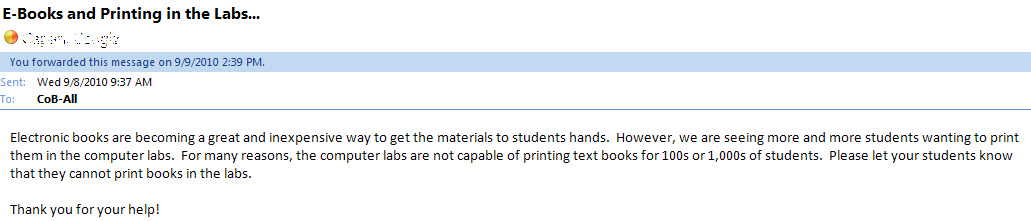
This got me thinking –

  • How do students best learn with digital textbooks?
  • Does this shape the curriculum in higher education when textbooks are mandatory, and e-books are more accessible for financial reasons?
  • What is the success rate for students who study with e-books?
  • Why are students printing digital books?
  • What is the learning curve for reading e-books vs. printed texts?

Here are just a few articles and posts about e-books & e-readers which are helping me review my options for e-books in higher education:

Faculty/students/staff – Please share your thoughts on e-books, e-readers and digital textbooks in higher education.

ATPI, Learning Technologies, PhD, Reflections

Determining Trends & Issues

The fall semester has kicked off into full swing and now the third week of school is coming to a close. This means many classes and assignments are underway, and the time for research and reflection is upon us – by that I mean homework and assignments.

ATTD 6210 – Trends and Issues in Applied Technology, Training and Development

A study of current national trends and issues in the fields of applied technology, training and development. Emphasis on topics related to leadership, organizational culture and total quality improvement.

The objective of this course is to research topics and trends that can best be applied to our professional fields of education, human resources and beyond since learners in our class have a varied professional background. This is one of the few courses for the ATPI Doc Program, and a starting point to engage in research and writing for publications. The goal for our first assignment is to provide a trends/issues report and key points to share for our next online session in Wimba.

Here are the “Trends/Issues” topics our class identified the other evening. This process took place after a review of over 100 articles,multiple reviews from peers, clustering of trend topics and debates of the groups (all completed in an online webinar format – FUN!) :

• Technology and Learning
• Workforce Diversity
• Performance Management/Consulting/Corporate Training
• Educator Quality – K-12 to Higher Education
• Learning Styles and Learning Models

Over the course of the term, I will do my best to include an article or thoughts on late breaking trends for a few of these themes listed above. I encourage readers to send any “hot topics” or readings I might have not stumbled upon on the way. I promise to commit a post or two each week for this reflection and sharing, as I think that blogging helps to work out the thought process and makes me a more informed learner/educator.

Past trends and tags from my blog include the following topics


Let’s see how much I can expand this Wordle by December 2010.

BreakDrink, CTC, Learning Technologies, Podcast

Back To School Time is Here!

In honor of back to school time of year, the Campus Tech Connection (CTC) crew hosted a two part series discussing online tools, resources, gadgets & more on the latest podcasts. Both professionals and students in higher education should take advantage of a few tech tools this coming academic year.

Photo credits: Back to School Kids! by jumpergirl on Flickr

This initially started with a blog post from Steve Wheeler (@timebuckteeth), a great edtech educator in the UK who discussed Tools of My Trade in a blog post back in March. In thinking about a few techie things we want to try out this year, we thought the CTC show would be a great forum to discuss and share.

Both episodes were jam packed with resources, so to keep you (and us) on track we archived both podcasts and the many links to all the tech tools that you might want to engage with during this school year. From personal learning networks, to screencasting and new apps to try  — these two podcasts have something for every educator.

Back to School Tech Tools, Part I Podcast & Resource List from August 2, 2010.

Back to School Tech Tools, Part II Podcast & Resource List form August 9, 2010.

Other great back to school techie lists out there:

We would LOVE to hear from you! Please contact the Campus Tech Connection with your feedback, suggestions, comments & more. Leave a message at 732-98-BREAK (27325), tweet with the hashtag#CTC or post a comment on the Break Drink Ed Tech Section and let us know what you want to learn about in the world of higher ed & technology: http://breakdrink.com/category/ctc-podcast/

Although we are off to pack our back packs this week, we shall return next Monday at 7 pm CDT for more Campus Tech Connection news. Stay tuned for the next couple of shows we have planned with some spectacular guests:

o      August 23rd – Sarah Robbins http://ubernoggin.com/ & @Intellagirl

o      August 30th – Alec Couros http://educationaltechnology.ca/couros/ & @courosa

Collaboration, Learning Technologies, Virtual Communities, web 2.0

Digital Nation: Life on the Virtual Frontier

Last month PBS aired a Frontline special called Digital Nation [full streaming episode] which shared thoughts about how technology is transforming global culture and society. This episode was a review of life on the virtual frontier, and a follow up to a previous Frontline special called Growing Up Online.

Thoughts around digital distraction, connection and learning technology were some of the various topics around emerging technology trends. The last section introduced ideas for education in the digital age. This was a pretty good segment to spark some thoughts and continue to probe questions about how we utilize digital resources in our society.

Vodpod videos no longer available.
CCK09, Learning Community, Learning Technologies

Visitor or Resident?

“Transparency is related to openness. Openness is most often related to content. Transparency, in contrast, involves making our learning explicit through forums, blogs, presentations, podcasts, and videos.” ~ George Siemens, Week 8: Openness and Transparency

Participation in #CCK09, the entire course thrives on learners and educators who are open and transparent in the learning process. David White joined the #CCK09 class to discuss his ideas on how Visitor and Resident learners impact the online educational environment [session recording].

Visitors & Residents: Original Blog Post & Presentation

v

Image c/o original V TV series

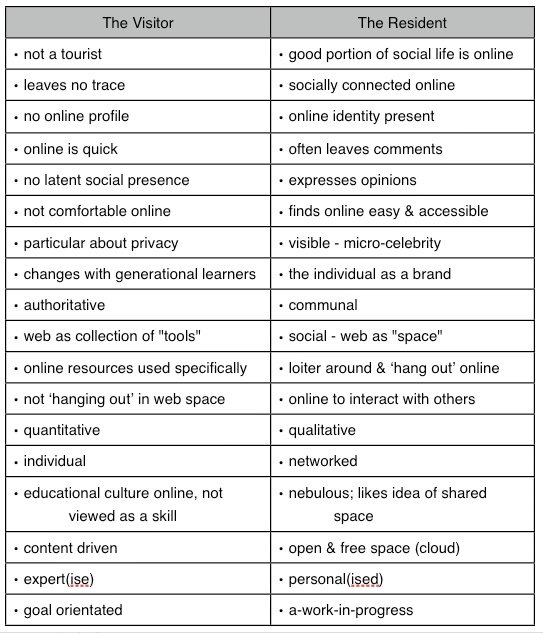
Much of this conversation was initiated with the JISC funded Isthmus project which was designed to bridge the gap between institutions and online learning, specifically how learners are utilizing technology. Instead of using the terms ‘digital native’ and ‘digital immigrant’ (coined by Marc Prensky in Digital Natives, Digital Immigrants 2001 publication), White sees learners as being a Visitor or Resident in their motivation for online education. Here is a quick Visitor vs. Resident comparison chart I created based on his presentation:

Visitor vs. Resident

In thinking about my own experience, as an online learner, I seem to fall in the ‘Resident’ category. I am very transparent and open online, and I am comfortable sharing my learning experiences and social experiences digitally. Although I am a resident, I can recognize a few visitor experiences from time to time, i.e. learning new tools, online resources and expanding my personal learning environment perimeters.

In thinking of the Visitor vs. Resident comparison, it is critical to think of it as a continuum rather that distinct categories. Students should not be labelled definitely into these categories since it is fluid. Each learner may have boundaries and limitations, however possess a willingness to be an open, online learner. As an educator, it is critical to create a learning environment online that provides structure and purpose online, while allowing learners to expand their creativity and knowledge as they see fit.