eduMOOC, Higher Education, Learning Community, Learning Technologies

Digital Education: Disruption, Improvements and What Lies Ahead

In this  Knewton infographic,  The State of Digital Education, statistics share what is going on with digital education, online learning and blended classroom environments. The internet and online environments have posed some disruption to learning; however this is not necessarily a bad thing.

Educators and educational institutions who effectively embrace this digital evolution have see learning environments flourish by implementing online, social tools for engagement. Through increased digital content, mass distribution and personalized learning, the classroom is morphing into a virtual learning lab to support peer collaboration and foster life-long learning skills.  Both higher education and K-12 will see more action in the cloud as the push for personal learning environments (PLEs), mobile learning, and open content helps to design instructional curriculum.

I, for one, am very excited to see increased game-based learning and study the impacts of learning analytics in these environments. That’s just one #EdTech gals opinion. What do you think?

Created by Knewton and Column Five Media

 

eduMOOC, Learning Community

#eduMOOC2 – What The Research Tells Us #eduMOOC

I’m just catching up with the #eduMOOC course modules this weekend, as my own local scholastic/work deadlines got the best of me over the last couple of weeks. During the second week, #eduMOOC2 – What The Research Tells Us was the topic for the #eduMOOC panelists: Dr. Karen Swan from the University of Illinois, Dr. Phil Ice from the American Public University System and Dr. Ben Arbaugh from the University of of Wisconsin.

The panel’s #eduMOOC 2 conversation focus for online learning research were guided by the following questions:

  1. What do we know?: 
    What are the most important findings to date coming out of online learning research?
  2. How do we know it?:
    What methodologies have been most commonly used in online learning research and what promising methodologies are emerging?
  3. What do we still need to know?:
    What are the most pressing questions that still remain unanswered?  Where is online learning research headed in the near term?

As a student, I currently participate in course work through a variety of models: in-class, online and blended learning environments. Many of my online Management classes for my minor, are online,”in a can” course format that are typically asynchronous, i.e. discussion board questions/replies, multiple choice exams, online submissions and team project assignments. This mode of learning works well for full-time professionals who work 40-60 hours/week while in graudate school. In thinking about my learning preferences, my engagement increases when course materials are interesting and require collaboration/synchronous participation (Skype conference calls, group planning in Wiigo, team writing projects in Google Docs). As an adult learner and busy professional, I can also appreciate the autonomy and self-direction an asynchronous course format provides during the semester.

Learner needs and effectiveness can be impacted with the implementation of emerging technologies. There is the Clark vs. Kozma debate between the media and the message as instructors test the waters with social web and open educational resources for learning environments. Social engagement and social presence can lend to greater online learning retention – depending on the course content and the intended learner audience. From my experiences with online learning/instruction, it has been great to see learner-driven course participation and the growth of peer-to-peer learning networks to support communities of inquiry for learning.

The measurement of social presence in online learning environments could be further reviewed to help educators prepare for the future of elearning. There is definitely a need to create greater educational research repositories to further validate online learning and online course assessment. Data mining and content analysis models are just a few suggested ways that educational institutions can utilize business models for measuring course design and development.
The panel also suggested a need to increase the pool of educational scholars who are researching online learning and teaching. I was surprised to learn that learning analytics and data-driven academic positions are not being filled. As a PhD student in an integrated program ATPI (learning technology, organizational management, educational psychology/research), I am often exposed to a variety of disciplines, researchers, publications and ideas that span across the fields. As a professional in higher education, I have held a variety of positions within student and academic affairs (residence life, career services, academic advising, first year programs, instruction) I get a different cross-pollination of ideas and resources.
 
More scholars need to consider collaborative efforts and cross-disciplinary research to move online learning investigation and development forward specifically in the suggested future research area listed by this #eduMOOC2 panel:
  • Repositories of institutional/educational research
  • Federation of large data sets for educational research
  • Quantitative assessment & measurement
  • Increased research in online learning
  • Globalization & cultures in online
  • Quality of learning
  • Linking outcomes to specific courses/institutional goals
  • Open Education Resources (OER) role in online learning
eduMOOC, Learning Community, Open Education, PLN, Virtual Communities

Online Learning Today with #eduMOOC

Last week, the #eduMOOC course with over 2, 500 participants located in over 60 countries participated in the first session topic Online Learning Today for the Online Learning Today… and Tomorrow course.
I will be honest – the massive, open and online courses format will not be taking first year undergraduate courses by storm. Many of my incoming students are concerned with transition from high school to higher education, and often stay clear of online courses in their first semester. In contrast, as a graduate student and self-proclaimed life-long learner, I like the autonomy and independence a MOOC has to offer. I like to connect, share and learn informally with others, so this is probably why I signed up for the course.  The first week’s session (Thursday 1-2 pm CT) was recorded and the PDF slides were archived for those who could not attend the live session. Here are a few key questions and ideas discussed from the panel:

Who do we serve in online learning today?

Online learning has typically met the needs of our non-traditional learners; however with the impacts and growth in emerging technology for education online learning is becoming a staple at most higher education institutions. As we are encouraged to “do more with less,” online learning is now required to meet the continuum of learners and learning pedagogues are not quite developed for many campus learning environments. Although online learning is just another dimension of learning, more higher education technology leaders need to identify methods for effective design and high-quality curriculum delivery.

Is the nature of how we learn changing? How? Why?

Both the learners and learner environments have evolved over the past 30 years. The delivery, medium, and evaluation of learning has impacted today’s higher education classroom. Emerging methods of curriculum execution and faculty instruction are beginning to increase learner engagement beyond our campuses. Online learning allows for fluid participation and continuous experiences. Learning has always been social; however new mediums now increase our learning networks across the globe and enhanced how learning objectives are reached.  

In order to meet the needs of global learners in higher education, more institutions will have to move forward with technology or be left behind. Other questions that were discussed by the panel include: 

  • How do for-profit vs. not for profit higher education institutions impact online learning? 
  • We may have one the access war, but have we won the accessibility war with online learning?
  • Are we considering universal design for learning
  • Is there still cannibalization of online learning? Disrupting College http://t.co/Jg8egj0 via @amprog
  • How are faculty, instruction & evaluations designed to review impacts for online learning?
  • What are the challenges for online learning today in 2011?
Captain Obvious point: Online learning is growing and many institutions are behind in their development and support for this type of learning. This fact is apparent. Take a look at most higher education course offerings online and how these courses are designed. Online learning IS growing, in terms of, demand, quality, global reach, resources, and access. What I am more interested is HOW higher education institutions will meet the demand of online learning? Institutions are currently struggling with decreased budgets, low enrollment numbers and maintaining staffing needs to support our student populations – just to name a few challenges.
 
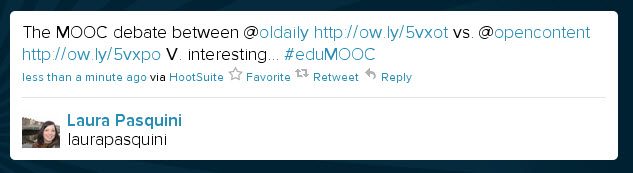
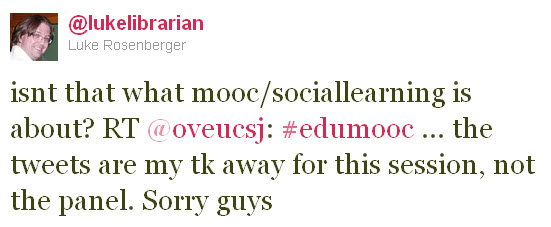
In reflecting about the session, I can not say that I came away from it learning a whole lot of new ideas – more these questions will shape what lies ahead in this course for the weeks to come. I was sort of disappointed that the panel did not represent any global educational leaders in the #edtech field as planned – but hopefully this will change in future sessions. And I did take note of the debates around the actual value of this #eduMOOC and other MOOCs for education and learning in a few blogs, Twitter and other online entities of the social web – which also has contributed to my learning. 

It’s this sort of discourse that most challenges me to think and really, a MOOC is similar to a personal learning network and what you decide to make of it. As a seasoned-learner, I find great value in on-going discourse that occurs on the #eduMOOC backchannel on Twitter, on the eduMOOC Fb group or just reading blog posts that share ideas and resources about the course topics. I encourage others to engage by following a few key hashtags [#onlinelearning #eduMOOC #elearning] and start a dialogue with your classmates. I still think the best types of learning from MOOCs comes from the community of learners and those participating in the learning network. As it was said best:

CCK09, EC&I831, eduMOOC, Learning Community, Professional Development, Virtual Communities

What’s A MOOC?

What is a MOOC? What it is not = 


Flickr photos c/o maraker & cobalt123

Many of my educational technology peers might have heard the term MOOC tossed around before. For those of you who are just hearing this acronym, let me further explain. MOOC = Massive Open Online Course. It is exactly as the title describes. Here is a further description from Jan Schwartz‘s article – Learnings from a MOOC:

In the MOOC, the facilitators aggregated the conversations on a daily basis via a mass email, took a few really good posts (in their opinion), and advanced the conversation by asking more questions and pointing the discussions in relevant directions. Their choice of good posts included both the pro and the con of topics of connectivism and connected learning. 

The term MOOC was recently shared in yesterday’s Wired Chronicle article . When I heard about this upcoming MOOC last week I was looking forward to this course. My past experiences in other MOOCs – EC&I 831 & CCK09 – have contributed to my professional development, academic research and personal learning networks.  As an on-going learner, MOOCs often cultivate my learning interests and challenge me to go beyond what I  learning realms.

The Center for Online Learning, Research and Service at the University of Illinois Springfield is currently welcoming participants to their upcoming eight-week MOOC starting on June 27, 2011. [You can follow @edumooc or the hashtag #edumooc on Twitter and check out the eduMOOC wiki if you just care to “lurk & learn”]:

Online Learning Today…and Tomorrow

This collaborative course is completely open and free. Check out the great schedule for weekly panel discussions with experts in field. This will be a fun learning opportunity for some and perhaps great professional development for others.  I also encourage you to check out Dave Cormier‘s videos that shares  “What is a MOOC?” and how to be successful in a MOOC:

Collaboration, Learning Community, PLE, SAchat, Virtual Communities

Let’s Get Visual with Data

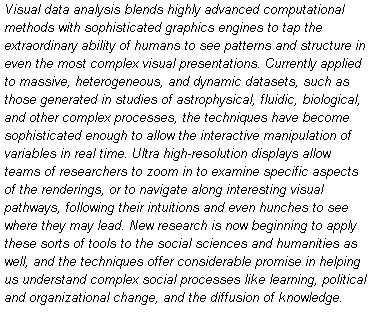
Fizz is one of the many ways to review and analyze online data. I am a visual learner. Naturally, I am intrigued with visual research and data analysis. The 2010 Horizon Report indicated that Visual Data Analysis will be  impacting technology and learning in higher education in the next four to five years:

Visualization tools like Many Eyes, Flowing Data, and Wordle are making statistics and data fun. These representations present actual facts and ideas in visual format to strengthen research and debates. Visualization tools help support learning and engagement for both educators and learners. Besides making meaning and giving access to facts, visualization allows learners to personalize and engage with data. A fellow doc student, Kevin Guidry, shared a great example of how to represent an online community in Twitter with his Visualization of #SAchat Data. Seeing this data allows more people to understand the dynamics of a community and how they connect online.

Another great proponent of visual statistics is Hans Rosling. Hans  is bring sexy back with statistics as he details his love of stats on the one-hour BBC documentary The Joys of Stats and his non-profit project Gapminder. For those of you who think statistics is a dirty word, I encourage you to take a gander at this one. If you are not afraid, I encourage you to get more visual with your research, learning and data. Here are a few resources to get you started – please comment and share more tools that you use & love to visualize data: