AcAdv, Higher Education, Learning, Professional Development, Social Media

Bringing Our Personality and Self(ie) to the Online

You can’t help but bring yourself to anything you are passionate about. I truly believe this.

Self-Love

This past week has brought conversation and debate prompted from a single blog post about The role of personality in education. Thank you, Martin. This post shared thoughts on how individual courses emerged with a “cult of personality” to drive it towards success, collaboration, interaction and then some. For these type of MOOCs, the learning design was intentionally focussed on the characters (Yes. Dave and Jim are characters… who I adore) to encourage participation and community in the vast Interwebs:

To be successful they often require someone with a well established online network to gather enough momentum, and because creating successful cMOOCs is hard work, that person usually needs to really be central in driving the course forward. And when this works well, it really does create a very engaging learning community.” ~ @mweller

I really think the “chalk and talk” can and should be changed for effective teaching and learning. This will take time, and much more than a popular face and/or a shiny technological platform to alter the culture of teaching and learning in higher education (online, blended OR F2F).:

…an understanding that public service is only a part of identity, and thus the educators who are engaging emergent technologies in the name of pedagogy and content need to be able and willing to build connections and relationships between the formal requirements of the educational system with the personal transformation of each individual.” ~ @RMoeJo

Of course, these ideas about personality and lead personalities are not always representative of the spectrum of learning we see leading these initiatives in higher ed. Social media has created opportunities for unique and powerful collaborations; however they have limited a voice from other populations. There are a number of flaws in elevating pedestals in online learning. Thanks for the reminder Kate, I appreciate her post to consider how we  reward and recognize privilege in our domain:

And on campus, we struggle with personality across student surveys and intellectual property policies: we haggle over the idea of the individual as creator of educational content whose expertise is the guarantee of student experience, while setting up procedures to assure the depersonalisation of content production so that students are protected from the vagaries of charm. Personality: can’t live with it, can’t live without it.” ~ @KateMfD

I am not naive in thinking a number of these social mediums and emerging technologies often influence the network, create affinity groups, and allow lead personalities to dominate. However; I am reminded these same social networks permit educators to customize student experiences, collaborate with researchers, and  build meaningful relationships to scaffold learning and inquiry.

A couple of weeks ago, I shared with student development and academic advising faculty/staff the only way I know how to best engage in what I do. To be myself, specifically, how to model your persona in the online to support student success and professional development on campus. In the #AdvSelfie session, we discussed how it is important, more than ever, to be present and engaged in the digital. More than ever we need to ask questions, be involved, and participate in the backchannel conversations happening at and around out institutions.

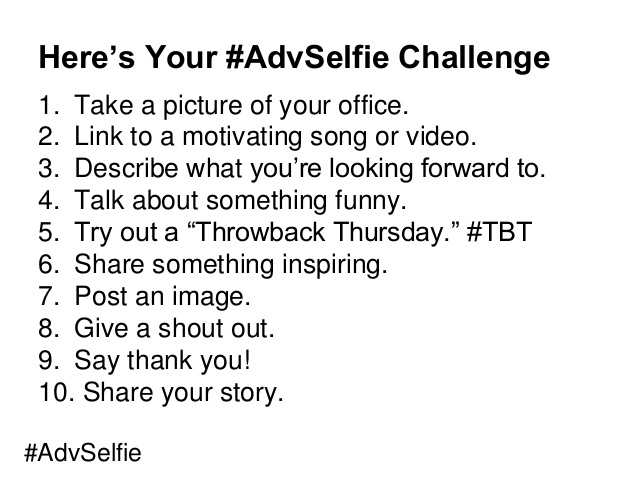
Mentoring and modelling online is the key to success for all in higher education — this includes our academic staff/faculty, administrators, staff, educators, and students of all educational levels. In an effort to engage in this dialogue, I challenged participants at the #NACADAmelb and other professional/faculty in higher ed online to BE PRESENT. This challenge stemmed from a 30-day challenge for those who are active online (or should be). To be the example for others on campus, I encouraged the advising group (hey – we all advise one way or another) to be the example with The #AdvSelfie Challenge – so you should probably participate as well:
the-advselfie-66-638_CHALLENGE

The #AdvSelfie Challenge: Post your best selfie showing how you mentor and model your online persona for your #highered campus (students, staff & faculty) with the hashtag #AdvSelfie before July 31, 2015 at 11:59 pm CDT. Prizes WILL be awarded … so get creative!

the-advselfie-7-638


UPDATE 08-14-15: And the winners of the #AdvSelfie Challenge Are….

Thanks to all of you who participated in The #AdvSelfie Challenge! It’s been great to see how you share some of yourself to colleagues, students, faculty and friends on campus. Kudos for being the digital mentors and models we need in higher ed!

Congratulations to the following “winners” of The #AdvSelfie Challenge:

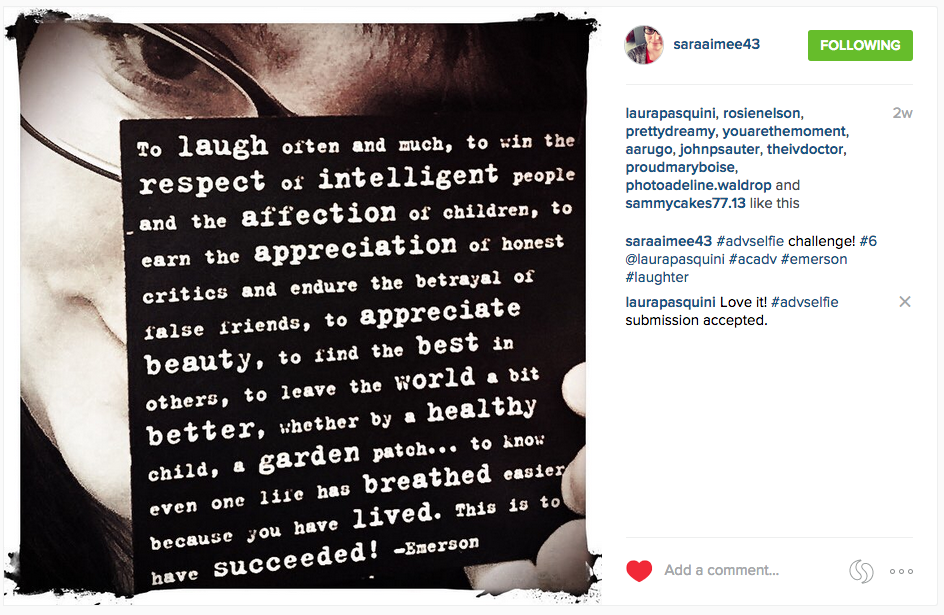
Sara Ackerson, Washington State University Vancouver, WA: For reminding her colleagues and students to laugh and find the best things in others for success.
SaraA

Amanda Mather, Texas A & M University at Qatar: For sharing who inspires and mentors her own advising career in high education.

AmandaM

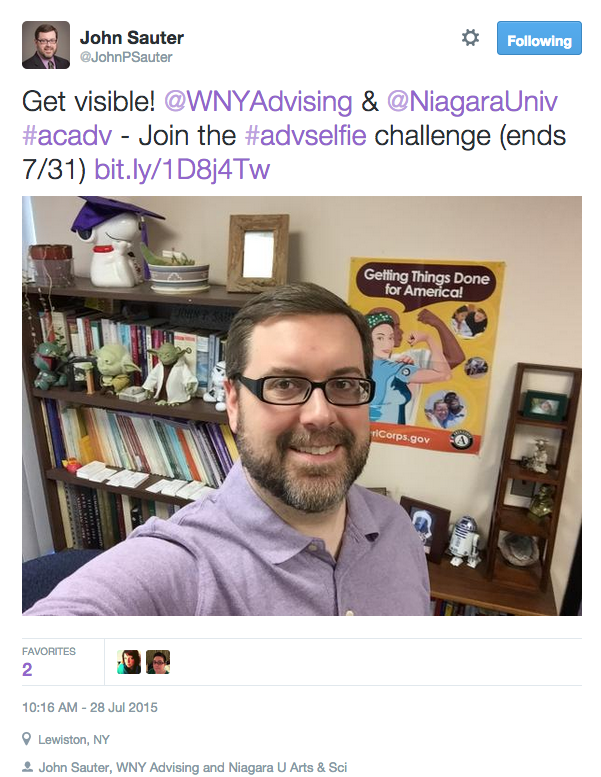
John Sauter, Niagara University, NY: For connecting his university and professional advising community in WNY to be active participants and engage online.
JohnS

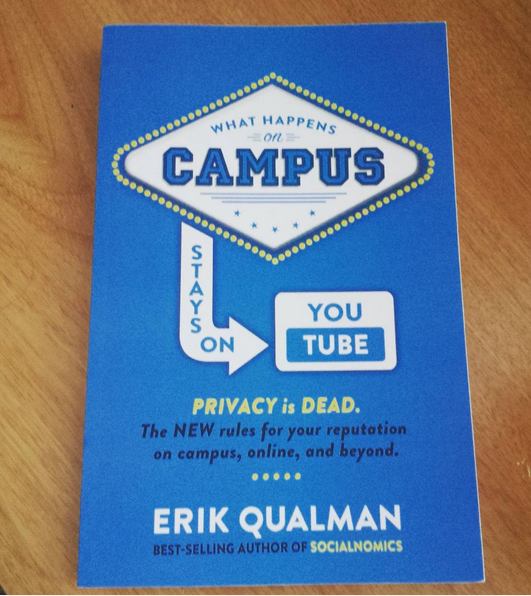
All winners will receive in the mail their own copy of the What Happens on Campus Goes on YouTube book shortly.
WHOCSY_book

Thanks for showing your #advselfie! Keep on supporting & being present online for your campus communities. Happy reading, y’all.

Learning, Learning Community, Rhizo15

Time to Drop the Mic Instructors: Learning Gone Wild {#Rhizo15 Week 4}

Thanks for your#Rhizo15 hack in week 4, Viplav. Your questions really got me thinking:

  • How do we really learn online?
  • How much of control and direction do we need?
  • How much of control do we want when we teach?
  • How do we expect others to learn in such environments?
  • What do we expect of them as co-learners?

For #Rhizo15, a strong and involved learning community, the answers are easier to navigate when we remove the instructor or when “DAVE’S NOT HERE.” With a number of educators who are passionate about learning and entrenched in thinking in #rhizo15, you are bound to keep the conversation going and the learners engaged. For most of us, we have experienced traditional pedagogical models and like the ideas of this sort of free-form learning and ability to dip into the curriculum as we like. Also, it won’t take much for someone to create a video, post a cartoon, record a sound cloud, or throw up a blog post on the topic of getting rid of the instructor. As co-learners, we thrive among the course banter and expect one another to contribute. So getting rid of Dave (metaphorically, of course) in #rhizo15, would not impact this course as much as we think (no offense, Dave).

Now, what would happen if we removed an instructor from a course? This could be online or face-to-face class. How would the learners react? When control is given to the course participants, will it be “Learners Gone Wild” or will our students take up the charge to contribute? My thought: it really depends on the course design.

drop-the-mic

These questions made me think back to my undergraduate days at the University of Guelph (Go Gryphons!), where most of my 4th-year history seminar courses were just that. As per the typical course syllabi, we were assigned weekly readings; however instead of coming to a “sage on a stage” lecture we were required to do the teaching. Each week 1-2 students volunteered  to offer a micro lesson, develop questions, and  facilitate the discussion on a topic. The professor often sat back in the class, and let us drive the critical analysis, synthesize the material, and debate about issues. It was GREAT! I thought – THIS is what learning is all about at university. I want more!

StudentCenteredTheories

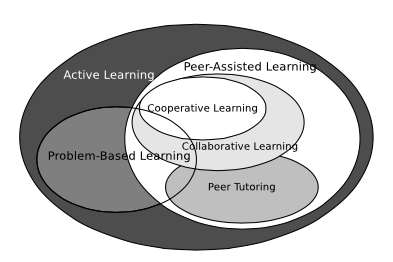
Student-centered learning theories & methods for flipped learning (Bishop & Verleger, 2013).

Student-centered learning is the key to deep learning, and although not described as “flipped learning” (Bishop & Verleger, 2013) back then, this is what most of my history faculty did at U of G. If you set up your curriculum to purposefully ALLOW for peer-to-peer learning, then removing the facilitator/instructor from the course may be just what you need. By creating intentional spaces (online or in-class) and opportunities for your students to co-learn, you might just be surprised on how they can bring more life to the course subject. During the course, instructors become facilitators of learning to support students with active learning strategies, such as individual problem-solving and team-based projects.Empowering your learners to take the reigns requires them to be embedded in the discipline of study. When you teach someone else about a concept, it requires a deep understanding of the material before you have to explain or critique it.

This does take some intention and planning in how you set up your course structure. It will be important for you to think about where, how, and when you want to infuse peer instruction and the support required for your learners. Think about how you want learners to contribute, lead, evaluate, and understand. When done well, this type of learning has huge benefits for both the instructor and leaders. There are so many possibilities to create dynamic interactions, meaningful conversations and critical thinking about your subject without your lead. Embrace the idea of “letting go of teaching” to see what might happen in part or all of your class. You might be pleasantly surprised at what YOU will learn from your students. Be sure to answer the following questions before you “drop the mic” as an instructor (adopted from Hoffman, 2014):

  • What positive opportunities can student-lead instruction offer your students?
  • How can instructors benefit from creating a cooperative learning experience?
  • What are the possible challenges students and instructors might with peer-assisted learning, and how might they be avoided?
  • What are evidence-based practices for learning environment without an instructor?

Interested in joining the #Rhizo15 world late or want to be part of the conversation and not just a lurker? Dave’s got a guide for that:

  1. This is a list of all rhizo15 blog posts
  2. Pick a title that resonates – click on it.
  3. Leave a comment
  4. Approach mirror, give the person in the mirror a high five
  5. Return contentedly to previous activity
Check out the course website http://rhizomatic.net or go to the hashtag on twitter #rhizo15
Also, you can write late blog posts (like me!) on any of the weekly topics.

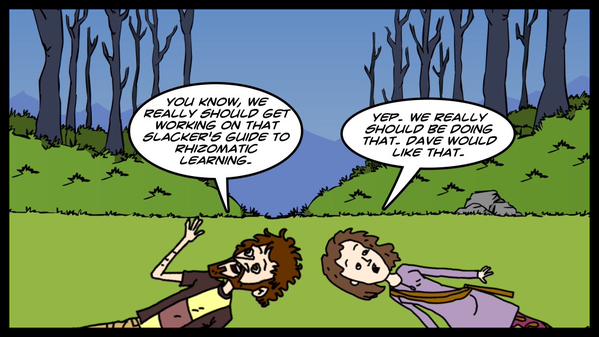
For those #Rhizo15 slackers like Kevin & me (well, myself more so), we’re working on said things. The Slackers #Rhizo15 Guide will be available… when we get around to it. 🙂

Slacker's #Rhizo15 Guide... to comeCartoon via @dogtrax (Thanks, Kevin!)

 References:

Bishop, J. L., & Verleger, M. A. (2013). The flipped classroom: A survey of the research. In Proceedings from the 120th ASEE Annual Conference & Exposition, Atlanta, GA.

Hoffman, J. G. (2014). The functionality and feasibility of flipping. Proceedings from the 25th International Conference on College Teaching and Learning, (pp. 112-126). Jacksonville, FL

Learning, Reflections, Rhizo15, Teaching

Measure This, #Rhizo15!

If you are teaching a course or conducting a training, those providing and taking ALWAYS want to know how you will measure success, learning, and performance. ALWAYS. What’s the bottom line? What’s the ROI? What’s the learning outcome? How will we know our learners have learned or our training participants “get it”? GRADES. SCORES. NUMBERS. STATISTICS.

This week Dave reminds #Rhizo15: “Learning is a not a counting noun.”

I am tardy in this post for a number of reasons (#et4online and #Fiachra40Fest, I’m looking at you). Without even knowing it, we actually had a late night discussion post-fire pit sing-song at the #et4online conference. {How did you get in our heads, Dave? Well done, sir.} Let me share a bit of that post-ukulele, harmonizing chat for you here.

FireSide

If you think about it, our learners are programmed to believe a grade informs their knowledge but is this actually the case? Grades evaluate an outcome; however it might not really mean learning. Do you know if your learners make meaning, identify value, or apply their knowledge beyond the assignment or specific course requirement? Grades have been there to offer benchmarks, set standards of evaluation, and help instructors measure FOREVER.

“You actually believe in grades?” asked Pete (a.k.a. @allistelling)

Great question. I thought about it. My response: Not really. As a faculty member, I have to provide an outcome or a grade for my students – but that is the university requirement and standard for our department. Our academic institutions require a numbered measurement to move forward in degree programs; however it is really the process of development, fine-tuning, and involvement where I see my students “learn” the most. For our students, a number is easy. It places them in a particular level or understanding of “how am I doing in the course?” Often they look at their learning in comparison to one another, and to figure out if they are “measuring” up to the learning standards. We could do better to “show you know” in other ways beyond a numbered evaluation. Really.

I am thinking more about the grades or non-grades in a couple of my courses. Two of my online courses are very much project/portfolio based, where the final product is built throughout the whole semester. My presentation class #LTEC4121 has a “TED” talk and short demonstration video, and my instructional design/facilitation #LTEC4440 class is building a 5-week online training proposal. Both of these assignments are very applied and relevant for my students; however a number of my learners are being pushed outside the comfort zone for their projects. Although most of the course evaluation (the numbers) are weighted towards the final projects, a few students will leave this course or give up based on early grade assignments. They are concerned about their GPA in this course, their cumulative GPA, etc. Those who stick past the first few weeks actually stop asking me about the numbers. Which is great! They want to know more about shooting film and editing, or considerations for putting media into their training course program. At the end of the course, I am impressed by their projects and final videos they deliver, here are a few examples of technical demonstration created last Fall 2014 :

In our fireside conversation, we talked about the value of developing artifacts, engaging in the peer-review process, how collaborative input matters, and working through revisions leads to understanding. With grades or marks (I’ll be inclusive to my Canadian & US colleagues), educators (myself included) often forget to model learning as a process. Learning should be developmental. As instructors, we need to remember to have our learners build upon previous knowledge and apply their learning beyond our course. There should be an opportunity for our learners to take risks, make mistakes, and pick up the pieces for the course and beyond. Making learning as not a number is not easy – for both the instructor and the students. There will be confusion and possibly frustration; however you have to be willing to work through the learning process with your students. I am thinking of just grading early items as complete or not, and providing feedback for their final projects. I am also considering what really needs to be accounted for in a letter or percentage grade, with regards to their final project developments. Finally, I do want to give credit for my students who have collaborated and learned on a local level. I have witnessed a number of connections thrive beyond a semester or course, as they support one another in work, life, and then some. Perhaps it is time to get rid of a few numbers to meaure what matters for learning for my next term… it would help with all the grading that I am now going to work on now.

p.s. If you are into learning about learning, it’s not too late to join the #Rhizo15 conversation… better late than never.